lbs
Case Studies
Case Studies
lbs

30 October 2025

Vanguard Projects as a Vehicle of Organizational Change: The Case of Luiss University

Authors: Antonio Daood, Niels Noorderhaven                                                                                                                                                                                                                                                                                                                                                                                                              Abstract: The landscape of tertiary education has been dramatically changing. As any other sector, the world of higher education institutions has been shaped by the transformations in the socio-economic context. In Europe, and worldwide, the size of the higher-education sector has been growing tremendously, both in terms of the number of universities and pool of students. Today, higher education institutions operate in a complex environment: first, they are heavily regulated by government, and are subject to the external evaluation of a broad set of third parties such as national evaluation bodies, international accreditation bodies and international rankings. Second, as universities are an important driver for domestic and international growth, countries are more and more actively competing for the increasing number of mobile students looking to study abroad. According to OECD data, with 6.1 million students worldwide that enrolled in a study program abroad in 2019, the magnitude of international mobility has more than doubled since 2007. Globalization and digitization made students around the world more aware of the quality of higher education institutions, and, not surprisingly, the top destinations of foreign students are top-ranked universities. These phenomena, together with the resulting “massification” of the educational offer, are making the market for students increasingly competitive, which demands a more entrepreneurial response from university. Such a hypercompetitive scenario places a lot of pressures on universities, with the ability to attract international students being one of the key indicators to evaluate the performance of higher education institutions. Italy is not an exception.In 2021, Italy has 98 active higher education institutions, 31 of which are private institutions: 20 universities and 11 online universities. In ten years, from the academic year 2010/2011 to 2020-2021, the number of new yearly enrolments (i.e., students with Italian citizenship enrolling for the first time at an Italian university – masters excluded) in all the Italian universities has grown by 14,55% (from 288.876 to 330.898), and the number of new yearly enrolments of foreign students in the same institutions increased by 37,88% in the same period (from 12.846 to 17.712). In this scenario, the different universities in Italy had heterogeneous performances, with some growing faster than the others. One of the universities standing out the most in the Italian landscape is Luiss University, which registered an increase in the number of new enrolments by 39,29% against the overall national increase of 14,55%, and a growth of 243,48% in the number of the new yearly enrolments of foreign students against an overall national growth of 37.88%. Download Case Study Richiedi Teaching Notes

30 October 2025

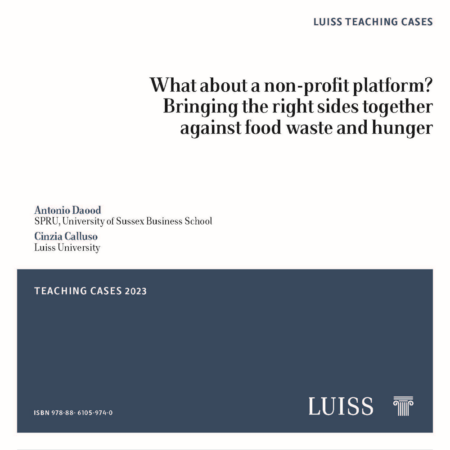
What about a non-profit platform?Bringing the right sides togetheragainst food waste and hunger

Authors: Antonio Daood, Cinzia Calluso                                                                                                                                                                                                                                                                                                                                                                                                              Abstract: The donation of surplus food has been developing significantly in Italy during the last two decades, but it still represents a smaller fraction of the total amount of food devoted to food aid as compared to the larger amount of food produced exclusively for the purpose – financed through national and communitarian programs (i.e., PEAD1 from 1987 to 2013, FEAD2 since 2014) targeting the Sustainable Development Goals (hereafter, SDG) number 1 (i.e., no poverty) and 2 (i.e., zero hunger). Indeed, these programs provide food aid to the most deprived, along with other basic material assistance (e.g., clothing, and hygiene products) and social inclusion measures (e.g., job assistance). These programs are approved by the Europen Commission and then managed by national authorities. After the production of food is assigned through calls for tender, products are transferred to food banks, from which they are distributed across frontline charities that deliver food aid to the poor. Over time, thanks to the increased attention to the problem of food waste (SDG 12.3), gradual regulatory advances have increased surplus food donation, making it available for providing food aid to people in need (SDG 2). Download Case Study Request Teaching Notes

30 October 2025

What happens in Vegas, stays in Vegas? A young traveler’s decision making problem

Authors: Fabian Homberg, Dennis Schoeneborn                                                                                                                                                                                                                                                                                                                                                                                                              Abstract: The case takes us to Las Vegas the capital of gambling in the US. The city is well known for attracting travelers due to its busy night life and casino density. In 2018, Las Vegas had more than 42 million visitors of which 20% indicated their gambling budget is more than USD 600. On weekends, the hotel occupancy rate is 94.5% (see LV Visitor Statistics website for details). Jack, a recent college graduate from rural Wisconsin, travels to Las Vegas. He has booked a standard room. Before travelling he searches the web for information about what to do in Vegas in order to plan his time in the best possible way. While doing this, he comes across a couple of blog entries talking about a so called “$20 sandwich trick”. He finds out that the trick refers to a common tipping practice people apply when checking in into their hotels in Vegas. This is how the trick works: During check-in hotel guests place a dollar note (typically a $20 one) between their credit card and ID (“the sandwich”), hand it over to the receptionist and ask for a complimentary upgrade (e.g., to a room with special amenities or a better view over the strip). The hotel clerk typically takes the sandwich, pockets the money, and sees what s/he can do for the guest. Enthused by the idea to get an upgrade for a low price, Jack really wants to try it when arriving at the hotel. One week later – it’s travel day! He arrives at the Bellagio hotel at 14:30 in the afternoon, and waits in the queue of travelers checking-in. While waiting his thoughts start to float and he thinks about the 20$ trick again. Suddenly he gets this odd feeling of doing the wrong thing – should he really play the $20 sandwich trick? Is it ethically sound? And is playing the trick actually a tip or a bribe? Download Case Study Request Teaching Notes
30 October 2025

WINDTRE’s Strategic Shift: Embracing a Multiservice Business Modeling the Telecommunications Sector

Authors: Maria Giovanna Devetag, Giovanni Zazzerin, Francesco Graziano                                                                                                                                                                                                                                                                                                                                                                                                              Abstract: This case explores WINDTRE’s strategic shi from a traditional telecom service provider to a diversified multiservice company, incorporating insurance and energy services into its portfolio. The diversification strategy capitalizes on WINDTRE’s robust customer base, technological infrastructure, and market insights, enabling the company to meet broader consumer needs while enhancing value creation. By leveraging cross-selling opportunities, WINDTRE not only increases customer retention but also taps into new revenue streams, mitigating risks associated with a single-industry dependency. This transition highlights the advantages of diversification, including enhanced brand equity, competitive differentiation, and resilience in a dynamic market environment. WINDTRE’s approach exemplifies how telecom operators can successfully evolve into integrated service providers, aligning with consumer demand for convenience and comprehensive solutions. Download Case Study Request Teaching Notes
30 September 2025

Strategie di riposizionamento: il caso Sandoz Italia negli equivalenti Branded (2023)

Autore: Matteo G. Caroli                                                                                                                                                                                                                                                                  Abstract: Il presente Teaching Case è stato redatto grazie alla collaborazione con l’Azienda Sandoz S.p.a. Il Gruppo Sandoz, leader mondiale nel mercato dei farmaci generici e biosimilari, opera con il purpose di essere pionieri nell’ampliare l’accesso alle cure ad un numero sempre maggiore di pazienti.La partnership prende forma dalla volontà della filiale italiana di Sandoz di accrescere la consa- pevolezza nella GEN-Z rispetto a tematiche sociali quali la differenza tra farmaci equivalenti e biosimilari, l’accessibilità alle cure e la sostenibilità del sistema sanitario. Il progetto condivide inoltre l’obiettivo della Luiss Business School di promuovere lo sviluppo sociale e la sostenibilità, attraverso le attività di formazione, ricerca e consulenza.L’esperienza e le best practice di Sandoz in Italia hanno costituito il cardine per la stesura di un testo utile come strumento didattico addizionale per studenti e futuri professionisti. Sotto forma di racconto, il paper ricostruisce e mostra le attività di pianificazione strategica che sottendono un posizionamento aziendale nell’ambito del mercato di riferimento.Frutto della collaborazione tra Sandoz e la Luiss Business School, il caso è un testo che offre una finestra su attività e dinamiche aziendali nelle quali i lettori potranno essere coinvolti nel corso della carriera professionale.L’obiettivo è quello di permettere agli studenti di “entrare in azienda”, immedesimandosi in tutte le funzioni coinvolte all’interno di un processo di riorganizzazione strategica; attraverso la lettura e la discussione del materiale, si favorisce la maturazione nel discente di un approccio critico alle problematiche aziendali e della capacità di individuare una soluzione efficace e coerente con il contesto aziendale. Download Case Study