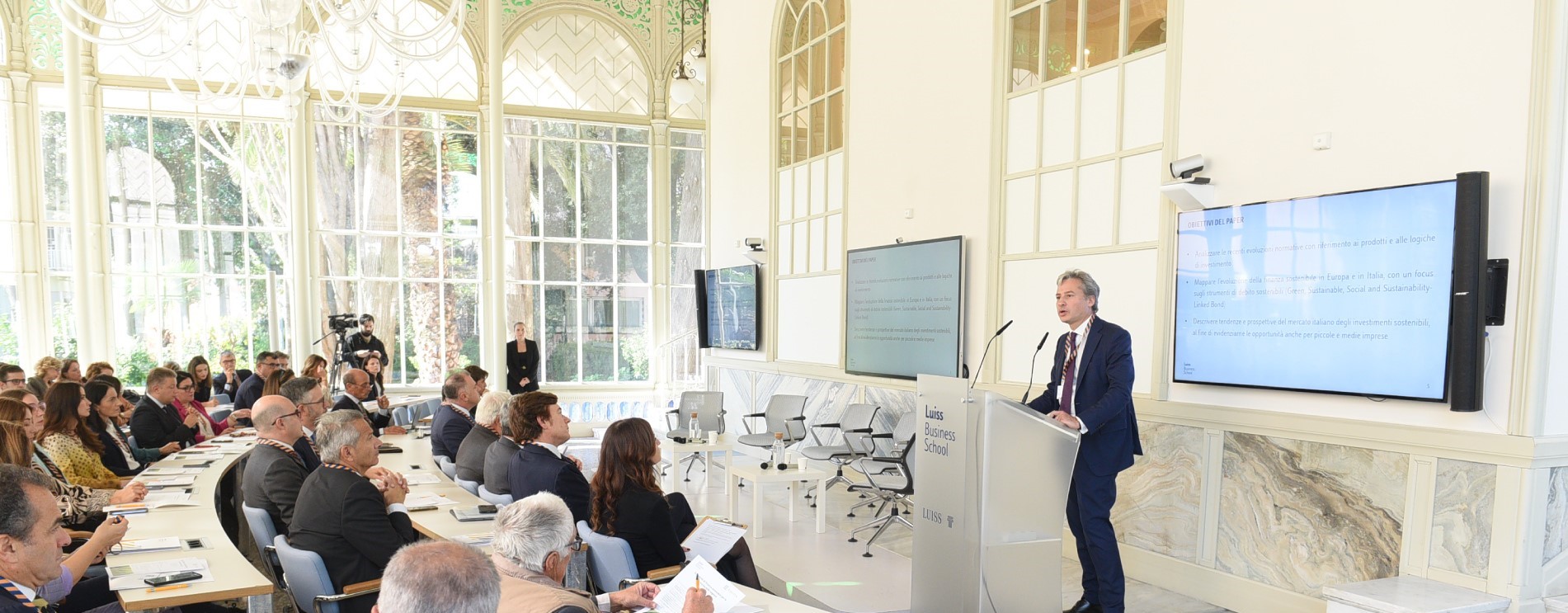
(by Paolo Spagnoletti, Scientific Director of EMIT Programme, LUISS Business School – Assistant Professor of Business and Management Department and Coordinator of CeRSI, LUISS Guido Carli University)
29/09/2015

IT infrastructures are dynamic systems whose growing complexity depends on the local, persistent, and limitless shaping of IT capabilities. This re-shaping results from the emergence of diverse communities with new learning and technical opportunities (J. vom Brocke, Braccini, Sonnenberg, & Spagnoletti, 2014). Therefore an IT infrastructure follows a trend determined by its social context and can be considered as a living system. The living IT infrastructures concept refers both to organizations, where business processes are vertically integrated in a hierarchical organization, and to innovative organizations where business models exploit the digital platforms (Resca, Za, & Spagnoletti, 2013).
As the relationship between IT and organizations evolves, the potential for new forms of organizing is continually created (Zammuto, Griffith, Majchrzak, Dougherty, & Faraj, 2007). On the one hand recent advancements in information infrastructures, platforms, and applications are blurring the boundaries between the physical and digital worlds by providing ubiquitous communication, sensing, and computing capabilities (Hanseth & Lyytinen, 2010; Yoo, Henfridsson, & Lyytinen, 2010). On the other hand individuals and organizations make use of IT as a resource for achieving their own goals in a given environment. This creates unparalleled opportunities for innovating current forms of organizing towards socially interactive, ethically sensitive, trustworthy, self-organized and resilient systems by connecting people and organizations. Nevertheless, IT also constrains practices and poses issues in terms of privacy, ownership, freedom of speech, responsibility, technological determinism, digital divide, cyber warfare, and other ethical issues.
In this situation, the governance of living IT infrastructures requires to balance the application of standardized procedures with the capability to lead the digital transformation of the organization. In order to enact effective governance practices, Chief Information Officers (CIO) and their IT staff need to master cost management and compliance tools together with models and methods for Information Systems (IS) development and maintenance. However, if CIOs want to play a leading role in the digital transformation of their business environment, they must also adopt a corporate management view on IT governance by challenging the alignment paradigm and developing a critical understanding of the opportunities and threats of digital innovation.
Recent works conducted by the Information Systems (IS) group at LUISS BS, have addressed emerging topics in the IT governance arena such as the design principles for the design of digital platforms supporting online communities (Spagnoletti, Resca, & Lee, 2015), the view of IS design as socio-technical construction and hence as an emergent process for engagement and learning (Spagnoletti, Resca, & Sæbø, 2015), the incident-centered analysis of information security settings and the balance between prevention and response paradigms for managing information security (Baskerville, Spagnoletti, & Kim, 2014). These studies have a direct impact on the teaching programmes at LUISS and the Executive Programme in IT Management & Governance of LUISS BS is the ideal target for translating these theoretical concepts into practice.
With the aim of making the EMIT Programme even more competitive at a national level, the VI edition has been designed both to preserve the key strengths that have determined the success of the previous editions and to better articulate the strategy and innovation module. The Programme is in fact recognized as a unique opportunity to acquire both specific competences on IT governance and horizontal competences. The former include business process management, security management, service support and operation management. The latter concern, for instance, project management, change management, and legal aspects. Participants are given the opportunity to obtain five certifications (COBIT 5, PMP, CBPA, ITIL, CISM) in two years. The revised module on “Strategy and innovation” – together with a set of thematic workshops on technology trends (e.g. Social Media, Mobile, Analytics, Cloud, etc.) and IT governance issues (e.g. cybersecurity, agile sw development, etc.) – will enable the participants to perceive the challenges of digital transformation and to consider their implications within the organizational contexts where they work .
References
- Baskerville, R., Spagnoletti, P., & Kim, J. (2014). Incident-centered information security: Managing a strategic balance between prevention and response. Information & Management, 51(1), 138–151. doi:10.1016/j.im.2013.11.004
- Hanseth, O., & Lyytinen, K. (2010). Design theory for dynamic complexity in information infrastructures: the case of building internet. Journal of Information Technology, 25(1), 1–19.
- Resca, A., Za, S., & Spagnoletti, P. (2013). Digital platforms as sources for organizational and strategic transformation: a case study of the Midblue project. Journal of Theoretical and Applied E-Commerce Research, 8(2), 71–84.
- Spagnoletti, P., Resca, A., & Lee, G. (2015). A Design Theory for Digital Platforms Supporting Online Communities: A Multiple Case Study. Journal of Information Technology.
- Spagnoletti, P., Resca, A., & Sæbø, Ø. (2015). Design for social media engagement: Insights from elderly care assistance. Journal of Strategic Information Systems, 24(2), 128–145. doi:10.1016/j.jsis.2015.04.002
- Vom Brocke, J., Braccini, A. M., Sonnenberg, C., & Spagnoletti, P. (2014). Living IT infrastructures — An ontology-based approach to aligning IT infrastructure capacity and business needs. International Journal of Accounting Information Systems, 15(3), 246–274. doi:10.1016/j.accinf.2013.10.004
- Yoo, Y., Henfridsson, O., & Lyytinen, K. (2010). The New Organizing Logic of Digital Innovation: An Agenda for Information Systems Research. Information Systems Research, 21(4), 724–735.
- Zammuto, R. F., Griffith, T. L., Majchrzak, A., Dougherty, D. J., & Faraj, S. (2007). Information Technology and the Changing Fabric of Organization. Organization Science, 18(5), 749–762. doi:10.1287/orsc.1070.0307