Challenges
Challenges
Challenges
Challenges

30 October 2025
Art and Science of Managing Paradox of Open Innovation

Author: Prem Sagar Menghwar                                                                                                                                                                                                                                                                                                                                                                                                               Abstract: In April 2021, Edward Robb, an entrepreneur, who has been running the family business for the past twenty years, looked back at the last decade’s performance of their companies Applied Medical Coatings and Robb Surgical. Applied Medical Coatings was born as a spinoff company from Metal Cladding in 2003. However, Metal Cladding was established in 1943 by Edward Hupt Robb’ great uncle of Edward Robb. In the last 75 years, Metal Cladding has been an industry leader in providing applied coating technologies that enhance products’ performance while increasing market sustainability at the optimum cost. Metal Cladding has mainly provided products and services to United States Federal Agencies and Armed Service Branches for nearly six decades. In comparison, Applied Medical Coatings (AMC) was established to provide services to the medical industry. The core capability of AMC is that it has the potential to design and develop multiple coating solutions according to the needs of its customers. The company values and uses feedback from its two main stakeholders- corporations and healthcare surgeons- to develop, design, and refine the products. Using a multiple-step iterative process, the company collaborates with stakeholders on developing a range of products manufactured in the USA. However, deliver at the same or lower price developed outside the USA, where production costs are much lower. To achieve this goal, the company collaborates, putting its core knowledge at risk. Each time it collaborates with partners, the company faces the classical paradox of open innovation – how to protect its knowledge while benefiting from external knowledge. So far, it has managed to preserve its internal knowledge and capabilities while collaborating with external stakeholders. However, a new partner has brought colossal business but has asked for complete information about the product development process. It has demanded that it inspects each step in order to ensure that the products meet the criteria. Edward doesn’t want to lose this big customer; however, he can’t also take the risk of sharing the core knowledge. Second, in 2013, another company, Rob surgical, was established as a spinoff company of applied medical coatings. This company works in collaboration with doctors and people who work at universities and has an idea about developing a new product. This company manufactures new medical devices and sells them directly in the market. This collaboration brings other communication challenges because doctors and engineers speak different languages. Besides this, the Covid-19 crisis has disrupted supply chain issues due to the lockdown and closing of elective hospital units. These challenges are critical and pose a risk to the sustainability of the companies; hence, Edward is thinking of approaching his father and engineering team, who has vast experience, and trying to find a way to address these issues to ensure the survival of his family business. Download Case Study Request Teaching Notes

30 October 2025

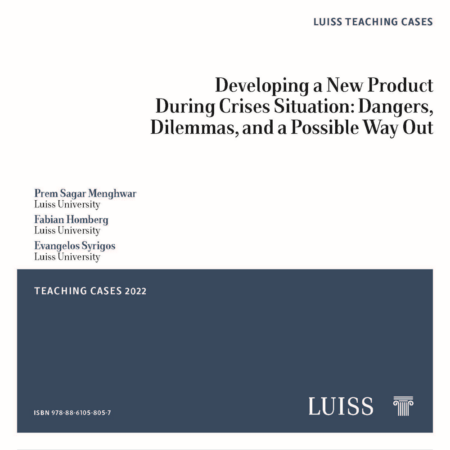
Developing a New Product During Crises Situation: Dangers, Dilemmas, and a Possible Way Out

Authors: Prem Sagar Menghwar, Fabian Homberg, Evangelos Syrigos                                                                                                                                                                                                                                                                                                                                                                                                              Abstract: All the well-known celebrities were rushing to the Asim Jofa office, they were seen stitching the suit as a message to skilled labour that they can also manufacture a product that is in high demand. The real story was not an invention but manufacturing a product that can be re-used and available for free for health workers. Asim Jofa and the team were convinced that this is the best time to do the philanthropic work. Hence, they jumped into it without assessing challenges, dilemmas and barriers a designer company could face when it takes part in the production of a product used in the health sector. The CEO of the company announced on social media that they plan to manufacture personal protective equipment — putting all the credibility of the company at stake if things go the other way around. Download Case Study Request Teaching Notes

30 October 2025

Elettricità Futura: the challenge for integration, innovation and sustainability in the electric industry

Authors: Matteo Caroli, Claudia Pongelli, Luca Silla                                                                                                                                                                                                                                                                                                                                                                                                              Abstract: Elettricità Futura represents more than 700 companies within the Italian electric industry. Overall these companies employ over 40,000 people and hold more than 76,000 MW of installed and conventional electric power and about 1,150,000 km of lines. Over 70% of electricity consumed in Italy is supplied by companies affiliated to Elettricità Futura (hereafter labeled as associates). Elettricità Futura associates electric producers both from renewable and conventional sources as well as distributors and service providers. Its mission is to support the creation of an efficient electric market and to meet the challenges of the future. Indeed, de-carbonization and energy efficiency require the development of renewable sources, the full use of high efficiency generation plants, the provision of adequate services, the development of the distribution system and the electrification of the final uses of energy. Although this organization is relatively new, it has roots in the history of the development of the Italian electric industry which has been experiencing radical changes in recent years. It was founded on 27 April 2017 from the merge between Assoelettrica and Assorinnovabili. Until then these two organizations were representing two very distant worlds as Assoelettrica was joining mainly large thermal producers whereas Assorinnovabili was linking a multitude of small producers of various types of renewable energy. Due to its ability to represent the heterogeneous Italian electric industry within a unique organization, Elettricità Futura has rapidly gained a strong institutional importance in Italy. However, the path towards the integration is anything but easy and the challenge for the future is to keep this unity over time as well as fostering the changes occurring in the industry. The case is organized as follows. With the aim to track the main characteristics of the context wherein Elettricità Futura has to operate, the first part describes the transformation that the electric industry in Italy experienced in the last twenty years. In the second part the case of Elettricità Futura is outlined. Download Case Study Richiesta Teaching Notes

30 October 2025

The St. Vincent Art Museum: Finding a way to face COVID-19

Authors: Luca Giustiniano, Sara Lombardi                                                                                                                                                                                                                                                                                                                                                                                                              Abstract: May 2020: Taking her traditional seat at the board’s table in the glass-casted room, Ann Hailstrom, Director of the St. Vincent Art Museum, looked extremely worried. On the table, thick books on Leonardo anticipated the plan for the next exhibition. Since her appointment as the Director, she had worked hard to make the St. Vincent Art Museum an excellent and faultless expression of high quality. Nonetheless, the totally unpredictable spread of COVID-19 had called off the entire year’s program. The severe uncertainty that the museum was facing was putting its survival at huge risk. While sitting, Ann knew that the board members expected her to come up with valuable ideas for prompt adoption to face the crisis that the pandemic was creating for the museum. Many questions were crowding her mind: “How can we be resilient in the face of the consequences of the virus? How can we keep on developing our activities yet preserve the high level of quality of our intellectual offer? What can we learn from these challenges to remain competitive? How can we incorporate the lessons learned into our strategy to compete better in the future with other cultural institutions in Europe? As soon as COVID-19 is over, how can we increase the attractiveness of the St. Vincent Art Museum to the international markets?” While reflecting, she also wanted to show the board how much effort she had put into looking at this tremendous moment as an opportunity to renovate the museum and some of its procedures and its ways of dealing with customers as well as its work activities. Waiting for all the members to join the meeting, from the other side of the room, the Grand Palace seemed to observe her with austerity. Download Case Study Richiedi Teaching Notes