Vision
Vision
Vision
Vision

30 October 2025

Deus ex Machina. It’s The Link, There’s No Thing

Authors: Federico Minoli, Enrico D’Onofrio                                                                                                                                                                                                                                                                                                                                                                                                              Abstract: In March 2020 Deus ex Machina’s (Deus) President and CEO Federico Minoli, a veteran of the sport and luxury industries with top roles at Benetton, Ducati, Dainese, Bally and POC Sports was confined by the Covid pandemic to his house in Boston. His bichon frisé Pepsi was looking at him anxiously, sensing that something was troubling the mind of her loving owner. Minoli was indeed struggling to imagine how to face the insidious threat that Covid-19 posed to Deus, a brand that he, together with a group of friends, had acquired only three years earlier. Minoli and friends had been attracted to Deus by the transformative potential of the brand and had imagined a worldwide expansion of a business still in its infancy. What is Deus Ex Machina? Is it a motorcycle and surfboard company? An apparel Company? A new concept of restaurant? An art gallery? A content producer? Deus is none of these things and at the same time it is all of them. Deus is a philosophy of life, an incubator of creativity, a generator of culture. It is anchored by Deus Temples, large venues that bring people together to enjoy music, food, shopping, and events – to watch a custom motorcycle take shape, or simply to feel relaxed and happy. It is the magic of a Temple that sets Deus apart and allows significant sales of Deus’ products also indirectly through a worldwide multi-channel distribution. The strategic issues around the post-Covid future of Deus were complex and controversial, and Minoli struggled to find the right answers. Download Case Study Request Teaching Notes

30 October 2025

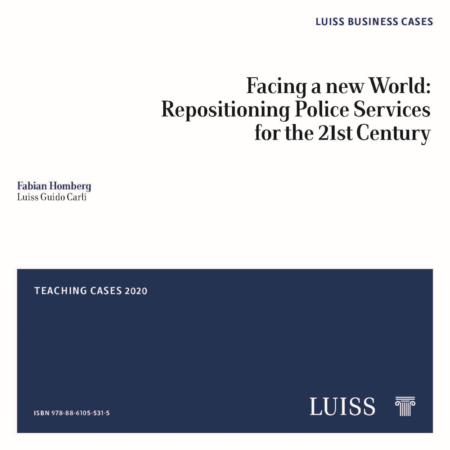
Facing a new World: Repositioning Police Services for the 21st Century

Author: Fabian Homberg                                                                                                                                                                                                                                                                                                                                                                                                              Abstract: It was the fifth of July 2016. Mr Oliver Schumann came home after a long day of meetings with mixed feelings. On the one hand he was happy as he had been charged with a major task which he interpreted as a strong signal of trust by his superiors. On the other hand, he was also worried because it was a daunting task. He works for a regional police force, and his boss asked him to lead a major repositioning initiative that involved a strategy redesign. The current strategy focused on “securing the region” was not adequately developed to address recent societal changes the police was facing at the time. Additionally, he knew from his own experience in the organization that most officers make fun about it and do neither find it appealing nor relevant. It was his first role as project leader and thus he felt a strong pressure to complete the project successfully. As a civilian employee he had been working for the regional police force for the past 3 years. Benefitting from a degree in strategy from a well-ranked institution he had been leading the police’s organizational development office since January 2013. This office develops, consults on and implements major organizational initiatives. Most of his colleagues look at it as being some form of in-house consultancy. Apparently, his superiors were satisfied with his performance on the job to date since he took over the position and hence, charged him with the task to lead the repositioning initiative. On the one hand, he felt proud and enthused about the fact that he was given such an important project impacting the whole organization. “It may be a real chance and also a very interesting project”, he thought. Also additional resources were granted to him in order to expand his team and an increased budget for the next three years highlighting the importance of the project. Thinking thoroughly about it, he concluded that the project has the potential to be the springboard for his next promotion – but only if it was a success! Thus, on the other hand he was very stressed, as he knew that a majority of change projects fail and that visions and strategies are easier written than implemented. For example, he vividly remembers the discussion that were triggered by a Towers Perrin Report launched in 2013 on the high failure rates of change initiatives. The headline still stuck to his mind: “Only One-Quarter of Employers Are Sustaining Gains from Change Management Initiatives”. At all costs, he wanted to bring the majority of law enforcement officers behind him and to deliver a successful strategy redesign. He also remembers reading a recent study by McKinsey stating that 49% of company redesign projects fail. It seemed that he would have to cross a bridge over troubled waters, he thought. The fact that he was employed in a rather civilian function, not being a law enforcement officer working on the streets on a daily basis might be perceived as an additional obstacle by the law enforcement officers who form the largest fraction of personnel in the organization. Also, time was pressing! He clearly was aware of the need to get feet on the ground and to start working on the project. But how should he start? His mind was spinning! Download Case Study Request Teaching Notes