30 Ottobre 2025
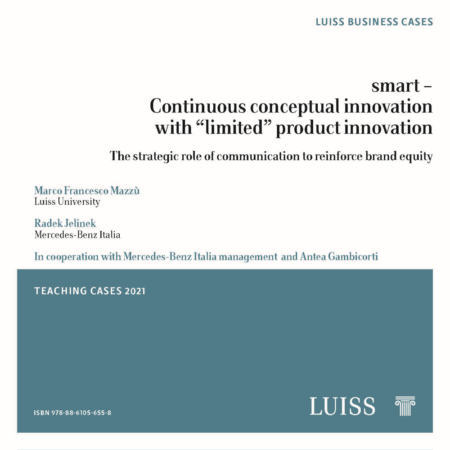
Autori: Marco Francesco Mazzù, Radek Jelinek. In collaborazione con Mercedes-Benz Italia management e Antea Gambicorti.
Abstract:
Summer of 1973, Radek Jelinek, an eleven-year-old boy from Brno, then Czechoslovakia, stood still for a moment in the Colosseum arena. His imagination went way back to the ancient gladiators and their tough survival quests and to something that he had heard during his trip: “Start by doing what’s necessary; then do what’s possible; and suddenly you are doing the impossible”. Two weeks after he had left with his parents for a vacation in a place other than another communist country, he did not know that the impressions of this very first trip to the “free world” would change his life forever. End of 2018, right after his appointment as Mercedes-Benz Italia S.p.A. President and CEO, Radek Jelinek was just returning from his first business trip to Böblingen, Germany, headquarter of the smart GmbH. It was a sunny day, and he had just met up with Annette Winkler, the smart CEO worldwide, to discuss the importance of, and the next steps to take in, the Italian market for the smart brand. Their paths crossed several times during their Daimler careers, the previous time had been one year before in Guanajuato, Mexico, when Jelinek was running Mercedes-Benz Mexico as President and CEO. They were celebrating the launch of a “smart city” campaign in Guanajuato, laughing and remembering the floods of water when a tropical rain shower hit the show during the press conference held in the dungeons of this ancient city, with Annette speaking to the press barefoot, holding her Louboutin high heels up in the air. Back then, Jelinek was in his 30th anniversary year with Daimler, where he had started as an intern; he later completed his thesis at the three-pointed star enterprise in Kassel, Germany, and escaped with only a backpack the drowning communist enterprise, defeated by liberal capitalism. From this town in central Germany he moved to the Daimler HQ in Stuttgart and later gained experience in highly volatile Argentina, followed by his first position of responsibility as CEO in a near-civil war situation in Chavez’s Venezuela. The 2007 Daimler-Chrysler de-merger when he was CEO of Chrysler in Germany, including the ensuing financial knockout worldwide when the company was transferred to Cerberus and later to the newly founded FCA Group, enriched his curriculum. When he hit the Italian shores for the first time in 2011, looking for a new job, he was appointed CEO of the Mercedes-Benz Brand Center and Retail in Milan. Facing the Italian market for the first time, he tried to understand the potential of the smart brand and learn about its history in Italy, even though the Mercedes-Benz side of the business had far more resources and obtained far more results. He was now reflecting on how smart as a product became a fashion icon and a success over time. The result of creativity, courage to innovate and hard work from the smart team in the market, as well as keeping the Italian management focused on pushing for a rather low-margin niche vehicle over a long period of time while maintaining a continuous conceptual freshness by giving the impression of continuous innovation in a context of limited product innovation.
Download Case Study
Richiedi Teaching Notes