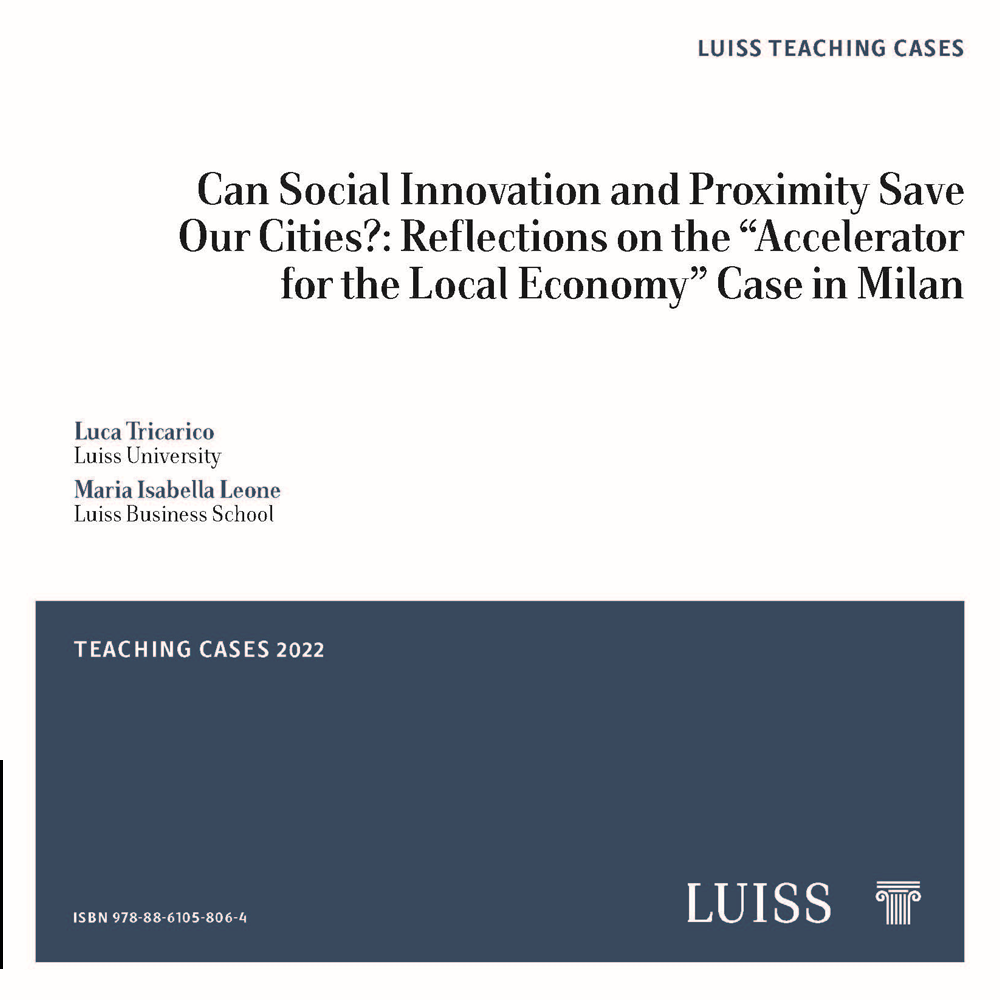
Autori: Luca Tricarico, Maria Isabella Leone
Abstract:
The disruptive effects of the knowledge economy paradigm based on technological innovation and creativity is still growing: even during the pandemic crisis, creative and digital competences are sought in diversified entrepreneurial sectors, in particular commercial services that are developed in urban contexts, increasingly intertwined with craft and digital manufacturing, new media, design, art and fashion. Local administrations in Europe and in the Italian context are looking for possible development models and strategies to support the diffusion of these initiatives: fostering the development of SMEs based on proximity-based business models and showing a new sensitivity linked to the themes of social impact of their activities. According to this background, the teaching case aims to discuss the background of an urban project that incorporates the social innovation and proximity-based entrepreneurial approach in its objectives. This case study is named “Accelerator for the local economy” (tr. Acceleratore per l’economia di territorio), funded by a National Government Fund and promoted by the Municipality of Milan in cooperation with a group of local partners (included the BU Luiss Hubs). The project has been implemented with a view to improve entrepreneurship, skills, and the creation of job opportunities in peripheral areas – a response from the Milan municipal administration in tackling urban marginality and the ongoing economic crisis resulting from the harmful effects of the Covid-19 pandemic. The case presents evidence of how social innovation-based approaches in entrepreneurship can tackle the aforementioned issues through new entrepreneurial approaches and place-based strategies (Mulgan, 2019; Barca, 2019; Geometta et al., 2005). Describing how urban policies can be delivered accelerating SMEs proximity features, inspired by innovative entrepreneurial practices sought during the COVID-19 economic crisis. The discussion will benefit the description of different business use cases that we can consider as good practices in supporting businesses and workers in the long phase of a proximity-baed urban transition and reorganization that the COVID-19 is still imposing.