News
News
News
News

31 March 2017

Problem solving with LEGO® SERIOUS PLAY® methodology

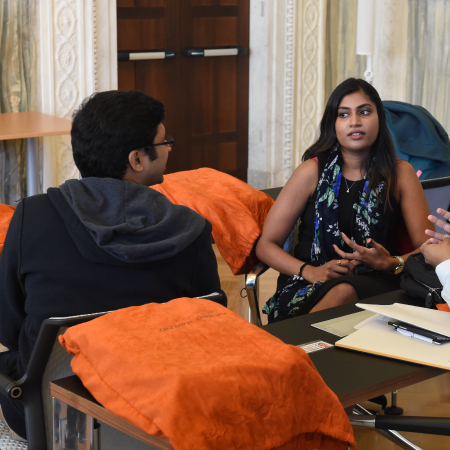
On the 9th of March MBA Part time students had the opportunity to confront themselves with a Case History in the FMCG field in which they experienced the LEGO® SERIOUS PLAY® methodology to improve the procurement function within a global organization. LEGO® SERIOUS PLAY® is an innovative and effective methodology half way between consultancy and training, designed to improve business results through the use of LEGO Blocks. The project was born in the 1990’s thanks to Kjeld Kristiansen’s initiative, he was the grandson of the founder of Lego® not to mention CEO of the company, who in order to promote the creation of a working group formed by Johan Roos and Bart Victor, both professors at IMD Business School in Lausanne, Robert Ramussen, Director of educational research of Lego® and Per Kristiansen Global Brand Director of LEGO®. The goal was to develop a strategic approach to Problem Solving for the management capable of breaking barriers and limited beliefs, opening up to new points of view and developing innovative solutions. “It is an extremely flexible facilitation, no predefined content - said Rachele Soliera, consultant and certified facilitator at LEGO® SERIOUS PLAY® - particularly suitable for all those activities that need to be developed or strengthened within an organization, such as problem solving, strategic thinking effective communication and team identity.” Participants use building blocks to build models representing metaphorically their thoughts, their challenges and their personal and professional aspirations. It is transverse methodology, cross - market and cross-function applicable in different contexts, orientated to business development, as much as teams and people. This methodology increases participants self-confidence because based on the precondition that every individual can offer unique contribution to the work of the team, and thanks to this participate in problem solving. The inclusive and involving approach changes the scope of commitment of individuals towards the team and allows them to transform classic meeting where 80% of the contents is generated by 20% of the participants in workshops with a 100% level and of commitment and involvement for all. For these reasons, it is a method that has been extremely effective for starting and/or ruling shared change processes; training and assessment; create project teams; manage risks or overcome team crisis situations; facilitate participation of planned processes for citizens and civil society; facilitate networking activities, get impacting insights; develop Business Model Canvas; resolve conflicts and deal with “indisputable threads” start start-ups. Propose students to experiment with innovative approaches and transversal activities is an aim of the Part Time MBA. In light of its horizontal application, LEGO® SERIOUS PLAY® favours the development of managerial skills that puts at the core of business the growth of individuals and team work. “ The application of LEGO® SERIOUS PLAY® methodology to the Business Case presented, is a solid example of its effectiveness - said Rachele Soliera - in a few hours students, according to the frame of the SWOT analysis identified and built up areas of strength and weakness, the threats and opportunities arising from the case concerned up to the shared Business Solution.” Gallery     31/03/2017

31 March 2017

Learning tour of the Krannert School of Management at LUISS Business School

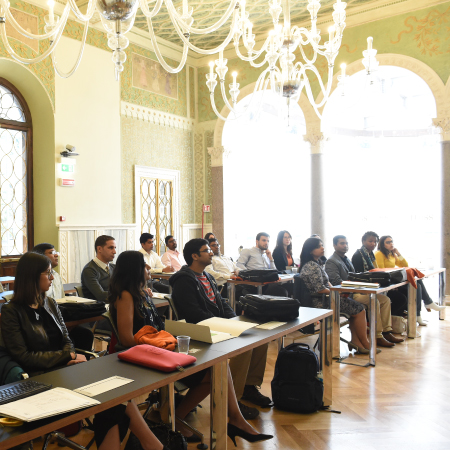
During the week of March 6th, a diverse group of Purdue University MBA/MS students from the Krannert School of Management visited the campus of LUISS Business School in Rome.  The Purdue group undertook four morning lectures that focused on the essentials of Strategies in Italian Entrepreneurship.  Among the specific topics the Purdue MBA students covered were Modeling & Value Innovation in Italy (by Prof. Rullani); Doing Business in Italy (by Prof. Zattoni); Micro/Macro EU Policy (by Prof. Maratin); and Entrepreneurship, Family Business & Districts in Italy (by Prof. Maiolini).  For many students, it was their first visit to Italy. The Purdue students valued the courses and information shared with them, and left with an appreciation of and a better understanding of the role of family in small Italian businesses, the four F’s of the Italian economy, Italian business relationships, the Latin Capitalism Model and the theory of value innovation specific to Italy. In addition to the lectures, students whole-heartedly immersed themselves in the local culture and participated in organized tours of the Colosseum, the Vatican Museum and Sistine Chapel, a walking tour of historical Rome, and a company visit to the Principe Pallavicini Winery.  Needless to say, the Purdue students enjoyed their week in Rome, with many students planning post-graduation trips back to enjoy the friendly people, vast history of Rome and most importantly enjoying the endless varieties of gelato.  “A big thank you! and Boiler Up! to our hosts at LUISS Business School, you made our international experience even more memorable!”   31/03/2017

29 March 2017

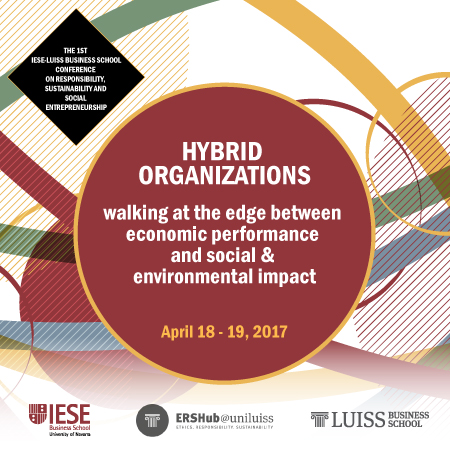
The 1st IESE-LUISS Conference on Responsibility, Sustainability and Social entrepreneurship

LUISS Business School and IESE Business School are equal partner in the organization of the Conference "Hybrid Organizations: walking at the edge between economic performance and social & environmental impact". Hybrid organizations are founded on the concept of hybrid organizing, "which we define as the activities, structures, processes and meanings by which organizations make sense of and combine multiple organizational forms. We propose that social enterprises that combine the organizational forms of both business and charity at their cores are an ideal type of hybrid organization, making social enterprise an attractive setting to study hybrid organizing". (J. Battilana, M, Lee, Advancing Research on Hybrid Organizing – Insights from the Study of Social Enterprises, in The Academy of Management Annals, 2014, p. 397.) The development of the global economic system has offered few solutions to many long-lasting problems affecting our societies, such as poverty or exclusion in the social sphere and climate change or water shortage in the environmental sphere. In these transformations, hybrid organizations have begun to play a crucial role: on the borderline between economic performance and social and environmental impact, hybrid organizations try to respond to social and environmental problems by applying market mechanisms (Ebrahim et al., 2014).  Hybrid organizations face the challenge of merging two different worlds, producing novel and sustainable solutions to pursue a positive and substantial social and environmental impact trying to reach both economic aims at the same time. This conference is aimed at gathering scholars from different literature streams interested in highlighting the mechanisms through which hybridity is created and sustained, focusing on the ways these organizations generate, preserve and expand their hybridity. An opportunity where the community of scholars conducting research on hybrid organizations, can meet, reinforce ties and create new ones, discuss new ideas and receive feedback. Key scholars in the field – among them Johanna Mair, Anne Claire Pache, Guido Palazzo, Tommaso Ramus and Ute Stephan –  will join the conference and present their work, to give more substance to the debate. A Thematic Symposium of Journal of Business Ethics on related issues, with the title: “Social Enterprises: walking ethically on the edge between economic performance and social and environmental impact” will be also showcased at the conference. CONFERENCE PROGRAM   29/03/2017

20 March 2017

The attitude to embrace changes, involve talents and take ethical decisions: leadership according to Marco Patuano

On  February 21 Marco Patuano, CEO of Edizione S.r.l was guest at L4T – Leader for Talent –  a series of meetings aimed for Specialized Masters and MBA students. This insight was written by Leone Bonanni, Student of Full Time MBA. On Tuesday, February 21st, full time MBA students had the opportunity to meet Marco Patuano, CEO of Edizione S.r.l through the LUISS Business School Leader for Talent series. The event was held in Sala Delle Colonne and students were extremely excited to get to meet such an influential Italian business leader. From the beginning, attendees could easily perceive Marco Patuano’s strong interpersonal skills, which are typical of today’s distinguished business leaders. As one of his main points, Marco Patuano stated that in order to be successful in our current and future endeavors, we must possess the right attitude. As future leaders, we must take pride in what we do and face every single challenge with our best effort. To be a successful leader, Patuano also highlighted that we must surround ourselves with talented individuals in order to maximize results both on a personal and a professional level. His team at Edizione S.r.l is filled with enthusiastic professionals who love what they do and strive to be the best every single day. Marco Patuano has worked in many different locations and has experienced significantly different working environments, which have allowed him to develop as a top executive manager. Patuano believes that future leaders must be keen to relocate in order to pursue a fulfilling and rewarding career due to the increased globalization trends that are taking place. Today, we live in a world that figuratively has no borders and there are potential opportunities all over the globe. The main challenges that a future leader may face are mainly related to globalization and the adaptation to changes with a particular industry. Adapting to certain changes within an industry is crucial if a firm wants to survive in a competitive environment. A leader must be able to embrace change and transfer his eagerness to change to his team ensuring positive results through high productivity and high employee morale. Another point made by Marco Patuano is that all leaders must behave in an ethical manner when making managerial and personal decisions. Patuano stated that when analyzing potential businesses to acquire, he makes sure to not invest in unethical industries or unethical firms. Today, ethics play a fundamental role in business activities due to increased visibility thanks to digital technologies and increased consumer awareness. Acquiring an unethical business may lead to devaluation of the whole brand portfolio, therefore a single wrong move may prove to be detrimental. There are also times when personal ethics may come into conflict with orders from the CEO. Marco Patuano described handling such a situation while working in Brazil and was able to deliver positive results to his CEO while preserving his own personal ethics by finding an efficient solution that worked for both parties. Making ethical decisions not only has a positive effect on the long-term sustainability of companies, but also safeguards individuals. The Leader for Talent series has once again proven to be a fantastic way for future leaders to meet current leaders and learn about the different challenges that leaders face on a daily basis. (Article by Leone Bonanni, Full Time MBA Student) Gallery 20/03/2017

16 March 2017

The Internet of Crimes: emerging challenges for IT governance

Cyberspace is opening new avenues for serious crimes targeting organizational assets and public goods. The availability of exploitation kits and easy to access anonymous infrastructures make possible to perform illegal actions such as identity thefts and data breaches by a large number of Internet users. The variety of people and the multiplicity of goals behind computer crimes makes difficult to predict the emerging risks faced by organizations which struggle in defending themselves from both social and technical threats. LUISS University and in particular the LUISS Business School is actively involved in this emerging area of research. Recently, for instance, a team of scholars led by Paolo Spagnoletti has conducted a study on identity thefts in TOR networks. Empirical data have been collected by accessing relevant marketplaces with software agents, in order to analyse how offers and suppliers are distributed within and across anonymous marketplaces. The results of this study will shed light on the dynamics of illegal activities in the dark web and hence on the changes in risk profiles of new product and services such as SPID. According with the principal investigator, “the research will have both theoretical and practical implications. From a theoretical point of view it will offer insights on market dynamics of online platforms under new conditions. As practical implications it will have a potential impact on the policies for developing digital infrastructures at national level”. The first EMIT speech of 2017 has given the opportunity to discuss these issues with guest speakers from the ICANN and the FBI. The VP Security and ICT Coordination at ICANN, Dave Piscitello has stressed the need of new approaches to digital product development and infrastructure governance in order to avoid that the history of internet threats will repeat with more dramatic consequences. The Special Agent Roderick F. Coffin from the Cyber Division of the Federal Bureau of Investigation has shared with the audience nuances on computer crime investigations in which he has been directly involved and has presented an updated overview of cyber-attacks. The event has been attended by members of the EMIT community including lecturers, current participants, alumni and representatives of partner associations such as the Rome chapter of ISACA Roma EMIT that has supported the organization. The Executive Programme in Management and Governance of IT of LUISS Business School targets professionals who wants to develop strong education in IT governance processes and practices. The programme has been established in 2010 in partnership with HSPI and the VII edition of the programme will start in March 2017. 16/03/2017

10 March 2017

Ericsson Innovation Awards 2017

A global competition that gives students the opportunity to develop innovative ICT ideas in collaboration with Ericsson experts. The theme of this year’s Ericsson Innovation Awards Competition is the Future of food and it is based on the UN Sustainable Development Goal 2: Zero Hunger and Goal 12: Ensure sustainable consumption and production patterns. Since the global population is expected to reach 9.6 billion by 2050, demand on our planet’s resources are rapidly increasing. Ensuring that world food production and consumption are sufficient and sustainable is a major commitment. This competition aims to challenges students to develop an idea for generating a positive impact in the future of food using technological innovations. ICT is helping to reduce material consumption and energy use and it also supports the reuse and sharing of products and goods: how can ICT contribute to the future of food, improving lives and the health of our planet? Join the competition and submit your idea by March 14. SUBMISSION Dates to remember January 9 – March 14: Phase 1 – Register your team and submit your idea. March 22 – March 30: Ericsson jury evaluation. March 31: Semi-finalists announcement. 10 team announced to go to semi-finals and receive mentorship from Ericsson Experts. April 3 – April 28: Phase 2 – Collaboration and mentorship from Ericsson Experts to create a minimum viable product and submit to semi-finalist judging. April 28: Semi-finalists submissions due. May 12: Finalists announced. TBA June: Final presentations and awards event. Location to be announced.   10/03/2017

02 March 2017

EQUIS Accreditation System Celebrates its 20th Anniversary

This year marks the 20th anniversary of EQUIS - EFMD Quality Improvement System, launched two decades ago at the Deans and Directors General Conference at Schloss Gracht, now part of the ESMT Berlin. This international quality benchmark and improvement process was created to give European and, subsequently, business schools worldwide, a rigorous tool to assess, certify and improve their quality in 10 key areas, including governance, programmes, students, faculty, research and, foremost, internationalisation, ethics, responsibility and sustainability as well as corporate engagement. Since its establishment, a strong emphasis on internationalisation and corporate connections have been the differentiating points of the EQUIS business school accreditation system. Coupled with recently added ethics, responsibility and sustainability standards, they have created a solid framework for quality measurement for international business schools. In 2015, LUISS Business School entered the élite of education having achieved this prestigious international certification, which acknowledges a limited number of Business Schools representing the 1% of managerial education. “EQUIS is a way of celebrating excellence in diversity and I’m delighted to see how the EQUIS system and the accredited schools have evolved in these 20 years. There is no one harmonised definition of quality but there is an excellence benchmark and a striving for perfection in the continuous improvement process,” adds Eric Cornuel, EFMD’s Director General and CEO. In its short history, EQUIS accreditation has become widely recognised by potential students, employers, the wider business education industry and the media as the most holistic and rigorous accreditation process, often being a pre-requisite for entry to rankings. With an estimated number of 15,000 business schools worldwide, only a handful (167 institutions from 41 countries) hold the EQUIS quality label, LUISS Business School is honored to be part of 1% of leading business schools. To commemorate this landmark achievement, EFMD plans to celebrate the success of EQUIS over the course of 2017 at EFMD events across the international community. More than 10 deans and experts who have contributed to the development of the EQUIS accreditation system have given their voices to the value and role EQUIS has played in enhancing the quality of management education worldwide as well as the future development of the management education industry. Here is the video: Source: https://www.efmd.org/blog/view/1334-equis-accreditation-system-celebrates-its-20th-anniversary 02/02/2017

24 February 2017

An ERS Lab to discuss several issues related to social entrepreneurship

On Saturday, February 25, LUISS MBA students will have the chance to participate in the ERS Lab with Dr. Funda Sezgi, Managing Director of Impact Hub Stockholm and Oriol Costa Lechuga, Managing Director of EcoRegió. This ERS Lab focuses on international replication of the Regionalwert AG (RWAG), a German social enterprise, in the Girona region of Catalonia (Spain) under the brand name EcoRegió.  RWAG is a highly successful network organization that brings together diverse sets of actors along a value-added chain (‘from the field to the plate’) of regional sustainable agriculture and food production initiatives. After implementing several replication initiatives in Germany, both Ashoka and the Catalan government identified the RWAG as one of the most promising models to be replicated in Catalonia.  In the summer of 2015, Oriol Costa Lechuga and his social venture Dynamis initiated RWAG replication efforts in Catalonia. Catalonia, like the rest of Spain, had just resumed economic growth after experiencing nearly seven years of economic contraction that resulted in unemployment and poverty rates in excess of 20% and in increasing political instability reflected in rising nationalist and pro-independence sentiment.  In spite of significant efforts made to promote EcoRegió, funds did not flow in as fast as Costa had hoped. The Lab will serve as an opportunity to discuss several issues related to social entrepreneurship (e.g., the scaling up of the social business, the internationalization of sustainable local enterprise networks, the impact of macro-economic and sociocultural contexts on internationalization processes, and social franchising as a specific mode of entry). In addition to introducing their organizations (Dynamis/EcoRegió and Impact Hub), both guests will actively participate in student group work. The Lab will use Proactive Café - a methodology for creative and inspirational conversation where participants are invited to share their questions (around projects, seed ideas etc.) and get input (deeper questions, knowledge, experience) from others, to help move from questions to actions. These conversations link and build on each other as people move between groups, cross‐pollinate ideas, and discover new insights into the questions or issues that are most important in their life, work or community. Topics are brought forward by participants themselves. There is no set agenda, only overall guiding questions, with the intention of deepening the learning process of all participants. The methodology can evoke and make visible the collective intelligence of any group, thus increasing people’s capacity for effective action in pursuit of common aims. Funda Sezgi, PhD Impact Hub Stockholm Funda is an Incubation Program Manager at Impact Hub Stockholm (IHS). IHS is a part of a global network of more than 80 organizations that unites people from every profession, background and culture with imagination and drive to pursue enterprising ideas for the world, the people who see and do things differently and have entrepreneurial passion to create sustainable impact. Funda holds a PhD in Strategic Management from the IESE Business School in Barcelona where under the supervision of prof. Johanna Mair she studied hybrid organizations, specifically issues of scaling and replication of these organizations. Funda’s professional and educational background, together with her expertise in replication and scaling of social businesses in Europe and wider make her an ideal participant in this ERS Lab. During the lab, Funda will introduce student to the work of Impact Hub around the globe and in Sweden, will talk about what it means to run an Impact Hub as a de facto entrepreneur, will introduce Proactive Café methodology of group work and several tools useful in analysis of replication and scaling problems of social businesses. Oriol Costa Lechuga, LL.B. Dynamis / EcoRegió Oriol has more than 15 years of experience in promoting strategies for sustainable development working as an expert in environmental, social and local economic development, recently focusing on linking sustainability and new technologies. As a part of his work, he developed an associative biography to promote self-awareness for social development, and boost the associative economy to increase economic, social and ecological awareness. Oriol is a co-founder and managing director of Dynamis, one of the most prominent social enterprises in the region of Girona in Catalonia, a hot spot of rapidly expanding social entrepreneurship sectors in Spain. The mission of Dynamis is to transform ideals into sustainable realities using modern technologies in promoting local and ecological commerce and through the elimination of unnecessary intermediaries. Their main activities focus on: (i) promoting direct local and ecological product commercialization through an easy-to-use, modern, and efficient online platform; (ii) improving the utilization of existing resources and the facilitation of synergies through the creation of networks of interdependent consumers and producers; and (iii) creating applications that favor dynamics of commerce, promotion, encounter, planning and reflection that generate new ways of acting and, in consequence, a more sustainable society. Oriol latest initiative is EcoRegió, an initiative whose mission is to capitalize on the economic value of a region and to produce for multidimensional social, environmental and economic benefits. Gathering capital from investors to invest in companies producing and distributing organic food, EcoRegió works toward the optimization of value added throughout the value chain – from the field to the plate. EcoRegió is a replication of The Regionalwert AG in Freiburg, Germany where the initiative has gathered more than € 3m among 600 citizen investors investing in 20 companies with excellent results recognized by Ashoka International, Ship2B, and the Generalitat de Catalunya.   24/02/2017

24 February 2017

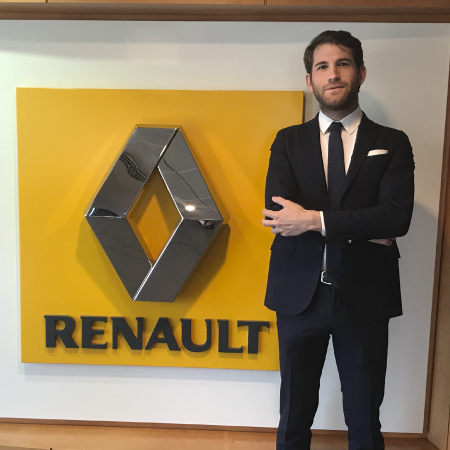
#MasterYourCareer - Continuous new stimulus and challenging international activities changed the way of conceiving my career: Carlo after the Master in Corporate Finance

 «Ambition, curiosity and need to challenge myself once again are the main reasons why I chose to enroll in the Master in Corporate Finance at the LUISS Business School»: the career of Carlo Venticinque after the MACOFIN   I graduated in Management Engineering and joined afterwards the Management Consulting company EY, where I worked for more than 2 years on different projects dealing with different areas from Operations Optimization to Business Development. Even though I was acquiring a good level of experience during these two years, I just felt I was missing something. Moreover, I have always been fascinated by the Corporate Finance world and its marvelous applications into the real life and in each business area: Finance is concrete and you need to know at least some if you aspire to become a good Manager. The Master in Corporate Finance at the LUISS Business School offered me the most complete and diversified path. It concerns different areas in which a manager should excel, not only the usual hard skills. We explored different aspects of finance from different points of view, while interacting with successful managers who shared with us their experience focusing on the skills the job market requires today. Not less, it gave me the opportunity to find smart colleagues who challenged me several times and pushed me to do better. The work environment is made of human connections and what really matters is the way we interact each other, how we communicate with people and especially how we inspire them. The most effective Communication and Public speaking lessons I have ever attended are actually the ones provided by the MACOFIN. The Global Business Opportunity Programme, an intensive educational path to develop an idea into s business project, and the Going Global Programme, a four month exchange at EM Lyon Business School, changed completely my way of conceiving my career and probably my life in general. These experiences enriched me with the smartness of the people that I met and helped me to realize that working abroad was what I was looking for. While I was looking for jobs in exchange, I discovered Flixbus, a company that is not widely famous yet but with an extremely interesting business model that is surprisingly expanding. I applied for a vacancy and then I joined the Business Development team for the Italian market. This working position is completely different from what I have done so far. The activities I deal with are not directly connected to the scope of the MACOFIN but I strongly believe that the knowledge acquired will be useful in my future path. I would suggest to the incoming students to leverage every single opportunity of interaction with the managers to get some good insights on how they climbed the career ladder  and what is really important to succeed in the workplace. I would suggest them to look continuously for new stimulus, following their own interests, and gather the maximum by all the international activities provided by the master to have great life experiences and build their network.   24/02/2017

23 February 2017

LUISS Business School Alumni Opening Event with Headhunters

LUISS Business School Alumni is glad to give a warm welcome to all its community members and new graduates, hosting the alumni association’s official opening event on February 24, at 6:00 pm, at LUISS Business School’s new campus Villa Blanc. The guests of the great event, managers of Key2People represent the Italian market leader in headhunting. Fabrizio Iaconetti, former LUISS student, and Partner at Key2People, will talk about the “engagement rules” with headhunters: how to catch their attention, and how to make your personal brand appealing. Cristina Calabrese, CEO at Key2People, will give an overview of macro trends in the job market, changes in HR processes, and different corporate policies. She will reveal the most relevant tips to be successful on the job market. The event will be opened by Giovanni Lo Storto, General Manager at LUISS University, and Nicoletta Luppi, CEO at MSD and President at LUISS Business School Alumni, who will talk about the recent launch of the new alumni association, and shed light on the new features of the business school’s international positioning. The closing remarks will be given by Paolo Boccardelli, Dean at LUISS Business School. The meeting on February 24 is a great opportunity to network with many other alumni and headhunters, and to celebrate the first official event of LUISS Business School Alumni at such an amazing and unique venue as Villa Blanc. In order to attend the association subscription is required, and the registration at alumniluissbs@luiss.it. Future plans of LUISS Business School Alumni LUISS Business School Alumni is launching some relevant projects and activities in three different areas: Networking, Career Consulting, and CSR. One of the most ambitious goals set in partnership with the Special Olympics and CSR Al Ahli Group is to launch a School of Social Entrepreneurship oriented to help the development of young inmates and young individuals in rehab from San Patrignano Community. The mission of the alumni association is to act as a social-changing agent and to use education as a means to change.   23/02/2017

No articles found