News & Insight
News & Insight
News & Insight
News & Insight

26 Maggio 2017

Come i Millennials valutano le aziende: la ricerca LUISS Business School promossa dalla Fondazione Coca-Cola HBC Italia

  La ricerca “Le dinamiche di selezione, valutazione, scelta degli studenti universitari verso potenziali employer” realizzata dalla LUISS Business School e promossa da Fondazione Coca-Cola HBC Italia, ha voluto individuare criteri che utilizzano i Millennials nella selezione degli employer a cui presentare la propria candidatura e avviare un percorso di carriera. Dalla ricerca – che ha visto la partecipazione di oltre 900 studenti universitari di un’età compresa tra i 18 e i 29 anni – tra i principali fattori determinanti sono emersi: emotional appeal, ossia l’atteggiamento emotivo verso l’impresa; workplace environment, in termini l’ambiente lavorativo offerto ai dipendenti,  tutela del benessere, programmi di formazione e di carriera proposti; performance finanziaria come valutazione della stabilità finanziaria con particolare riferimento alle prospettive di crescita dell’azienda, davanti a componenti più concrete come il livello retributivo offerto e la qualità dei prodotti. «I ragazzi coinvolti nello studio considerano l’emotional appeal il fattore più importante nella scala di valutazione, inteso come capacità di ispirare fiducia e ammirazione – afferma Luca Pirolo, Direttore del LUISS Creative Business Center della LUISS Business School – a testimonianza della ricerca di un sistema valoriale a cui aderire, prima ancora di una condizione economica ottimale». Non mancano inoltre il  valore percepito attraverso l’esame dei prodotti e/o servizi offerti; vision e leadership; social responsibility ossia l’impegno di carattere sociale, etico e ambientale da parte dell’azienda. «Il rapporto tra imprese e giovani generazioni appare oggi prioritario – ha dichiarato Giangiacomo Pierini, Vicepresidente della Fondazione e Direttore Relazioni Istituzionali e Comunicazione di Coca-Cola HBC Italia – e questo studio fornisce un supporto alle aziende per comprendere meglio quali contenuti risultano più interessanti, con quali strumenti comunicarli e come supportare i giovani nell’ingresso del mondo del lavoro. I temi emersi sono parte integrante del progetto #YouthEmpowered, avviato da Coca-Cola HBC Italia per fornire ai giovani una preparazione al mercato del lavoro. L’iniziativa, oltre a moduli formativi interattivi online, prevede incontri con le persone dell’azienda, che possono testimoniare direttamente i valori e l’ambiente lavorativo in cui operano ogni giorno, elementi che secondo la ricerca svolta da LUISS Business School risultano essere di primaria importanza per gli studenti». Gallery 26/05/2017

23 Maggio 2017

Building a global Perspective: the story of Wen Ting Chang, LUISS MBA class of 2016

MBA 2016 Prior to the LUISS MBA, I worked for the Ministry of Foreign Affairs in Taiwan. I had accumulated significant experience in organizing diverse activities, including governmental ceremonies and visiting programs of foreign political leaders. I had also led one branch of a renowned Taiwanese educational institute, setting annual plans and budgets, and our team was recognized as best branch of the year. After all this experience in Taiwan, however, I realized that I needed to “Go Global” to become more competitive in the dynamic global business environment. The LUISS MBA was appealing because it helped a person like me, with limited financial and economic experience, to build a solid knowledge of business, both hard and soft skills. The most critical part of the program was the international perspective shared between the diverse nationalities of faculty and participants. This allowed me to meet, work and become friends with people from around the world. My most memorable MBA experience was with an international social impact program. The project was in partnership with Energia per i Diritti Umani (Energy for the Human Rights), a non-profit organization financing and managing schools for children in Senegal, Gambia and India. Our team participated in a competition called “MBA for Africa”, in which we designed, under time pressure, a game for Senegalese children to educate them on the importance of team work and role play. Following the competition the organization brought the best design to Senegal, teaching children there how to play the game and understand the lesson behind it. I was thrilled to have strengthened my ability to work in a group under pressure, and we learned the power of bonding. Each team member had distinct backgrounds with different work patterns and habits. To achieve high-performance, we needed to build trust and have each person in the right place to conquer the challenge.   This experience gave me the opportunity to DO something meaningful for society, contributing as a member of the global village. The LUISS MBA program was intense but worthwhile. It enriched my global perspective and my personal experience. I have become more confident and ready to confront and solve challenges. It was also a place to nourish my awareness of social global issues. In the end I achieved my goal. I have developed my career into the next level and am enthusiastic about my life and future. 23/05/2017

22 Maggio 2017

#MasterYourCareer - Le difficoltà sono solo lo spunto per il successo: Greta, Analyst presso IBM dopo il Master in Corporate Finance

«Il Master in Corporate Finance è stato una realtà formativa a 360°. Sin dalla prima prova di ammissione mi è stato insegnato che nulla viene regalato, ma bisogna guadagnarsi tanto quanto più si è disposti a combattere e a superare i propri limiti. Conclusosi questo percorso formativo le offerte di lavoro non hanno tardato ad arrivare»: Greta, Analyst presso IBM nel centro Amministrazione e Finanza a Bratislava, il centro più grande in Europa. “Se vuoi qualcosa, vai e prendila. Punto.” (da “La Ricerca della Felicità”)  Sono Greta, ho 27 anni ed una gran passione per il mondo della Finanza. Conseguita la Laurea Magistrale in Economia, Management e Finanza d’Impresa con il massimo dei voti e, ahimè, un’offerta del lavoro scarseggiante ho sentito ancora di più l’esigenza di specializzarmi nel settore; da qui la decisione di iscrivermi al Master in Corporate Finance presso la LUISS Business School. Dalla prova di selezione il livello di inglese non risultò sufficientemente alto per accedere a quel tipo di Master, eppure questo non è stato di certo un buon motivo ad essere in grado di fermarmi. La settimana successiva, infatti, partii per Londra per 6 mesi con l’obiettivo di migliorare la lingua. In quest’arco temporale ho avuto modo di studiare in una English School e lavorare in un ristorante. Esperienza costruttiva e non poco facile in un contesto del tutto differente dalla “comoda” quotidianità, ma al rientro superai l’ammissione con grande soddisfazione. Sintetizzare il Master non è semplice, per me è stata una realtà formativa a 360°. Sin dalla prima prova di ammissione mi è stato insegnato che nulla viene regalato, ma bisogna guadagnarsi tanto quanto più si è disposti a combattere e a superare i propri limiti. Ovvio che i momenti duri e sconfortanti non sono mancati, dove il primo pensiero è stato quello di mollare tutto: in realtà sono state proprio queste le occasioni a ricordarmi che stavo andando nella giusta direzione. Se uno specifico percorso fosse facile potrebbe essere intrapreso da tutti, ma nella nostra unicità fortunatamente non è cosi. Il duro lavoro è stato ripagato, e se proprio devo essere sincera ho acquisito conoscenze e competenze più di quanto potessi aspettarmi: la possibilità di affrontare casi aziendali con Top Manager e docenti altamente qualificati, la valorizzazione delle diversità in un ambiente internazionale, condivisione, confronto, lacrime, sorrisi, amicizie, idee, sfide e crescita, sia a livello professionale sia a livello di soft skills. Conclusosi questo percorso formativo le offerte di lavoro non hanno tardato ad arrivare, prima uno stage di 6 mesi nel dipartimento Amministrazione, Finanza e Controllo in Costa Crociere, nella sede principale di Genova. Poi la proposta di un contratto indeterminato in una delle più grandi realtà americane nel settore informatico a livello globale: IBM. Attualmente ricopro una posizione Analyst nel centro Amministrazione e Finanza a Bratislava, che si è rilevato il centro più grande in Europa. Con grande entusiasmo qui ho veramente la possibilità, nel quotidiano, di mettere in pratica tutto ciò che ho appreso durante il Master, con un team davvero eccezionale. Non potevo chiedere di meglio, ovvio che c’è ancora tanta strada da fare, ma i buoni propositi e la voglia di rimettermi di nuovo in gioco non mancano. Dicono di me che sono tanto ambiziosa quanto combattiva, e non posso negarlo. Ciò che sento di consigliare ai futuri studenti LUISS Business School è di intraprendere questa strada con passione, motivazione, determinazione e responsabilità. Abbiate sempre il coraggio di accettare le sfide che si presentano nella vostra vita, le difficoltà non mancheranno: fatene spunto per i vostri successi. 22/05/2017

16 Maggio 2017

Il ruolo delle organizzazioni ibride

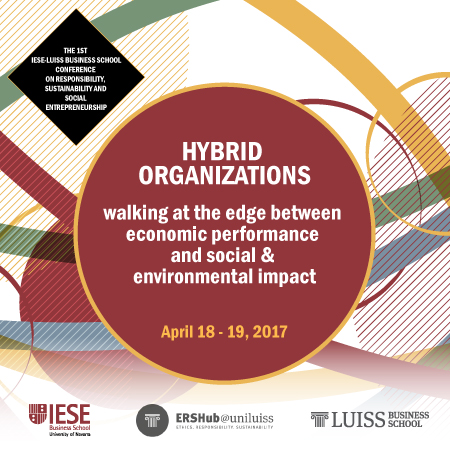
Il 18 e 19 aprile 2017, più di 100 accademici provenienti dalle più varie parti del mondo, dall’Australia all’America Latina all’Europa, sono venuti a Roma per partecipare alla 1° CONFERENZA IESE-LUISS BUSINESS SCHOOL SU RESPONSABILITÀ, SOSTENIBILITÀ E IMPRENDITORIALITÀ SOCIALE. Ispirati dalla bellezza e dall’armonia del Campus di Villa Blanc della LUISS Business School, gli accademici partecipanti hanno presentato i loro lavori, hanno dibattuto e condiviso le rispettive idee sulle Organizzazioni Ibride, strutture che creano impatto socio-ambientale positivo attraverso i meccanismi del mercato for-profit. Come spiega Francesco Rullani, Assistant Professor LUISS Giudo Carli e Direttore Accademico e Coordinatore ERSHub - Ethics, Responsibility and Sustainability Hub della LUISS Business School: “L’idea è quella di provare a capire come possiamo creare organizzazioni che siano in grado di raggiungere differenti tipi di obiettivi allo stesso tempo. La stessa attività che svolgono per sopravvivere economicamente dovrebbe generare un impatto positivo sia sul piano sociale che su quello ambientale”. Fino a non molto tempo fa i principali modelli economici offrivano poche soluzioni ai molti problemi di lunga durata sociali ed ambientali che affliggono la nostra società. Povertà ed esclusione nella sfera sociale, cambiamenti climatici e carenza idrica nella sfera ambientale sono solo alcuni dei più visibili esempi. In tale contesto, le Organizzazioni Ibride hanno iniziato a giocare un ruolo cruciale. “Negli ultimi dieci anni abbiamo osservato l’emergere di un numero crescente di organizzazioni ibride, imprese sociali, cooperative, organizzazioni che stanno giocando un doppio ruolo nella società. Da un lato contribuiscono alla soluzione di problemi sociali, dall’altro creano lavoro e svolgono una funzione professionale e competitiva nel mercato” afferma Antonino Vaccaro, Associate Professor e Academic Director del Center for Business in Society IESE Business School. “La creazione di valore economico, sociale ed ambientale non potrebbe essere possibile senza Etica, Responsabilità e Sostenibilità, tre punti fondamentali che riassumono le abilità che un bravo manager deve possedere, ma che inoltre rappresentano l’obiettivo centrale della strategia della nostra Scuola – Spiega il prof. Paolo Boccardelli, Direttore della LUISS Business School - noi vogliamo contribuire allo sviluppo  di una nuova classe di leader capaci di creare soluzioni per un mondo migliore”.   16/05/2017 PROGRAMMA 1° DAY Tuesday 18 April, 2017 Ph.D. and Early Career Symposium Behind the scene’ of writing and publishing on hybrid organizations Round tables First keynote session chair Francesco Rullani Johanna Mair - Innovation and Scaling – How effective Social Entrepreneurs create Impact Anne-Claire Pache - Social Enterprises as Hybrid Organizations: A Research Program Ute Stephan - Market-based Organizations and Strategies for Positive Social Change Semi-plenary session  I Semi-plenary session II 2° DAY Conference: Wednesday 19 April, 2017 Parallel session I Parallel session II Second keynote session chair Antonino Vaccaro  Tina Dacin - The role of social entrepreneurs as market builders and custodians Guido Palazzo - From Aeneas to global warming to social entrepreneurship - Reflections on the transformational power of values, beliefs, stories and narratives Tommaso Ramus - Strategic framing in a new “social movement enterprise” Presentation of the Journal of Business Ethics symposium Luca Mongelli Third keynote session: Firms challenge Academia chair Michele Andreaus Tina Dacin Guido Palazzo Vincent Fauvet Luigi Sampaolo KEYNOTE SPEAKERS Johanna Mair, Hertie School of Governance, Germany, & Stanford, US) Anne-Claire Pache, ESSEC, France Ute Stephan, Aston University, UK --- Tina Dacin, Queen's University at Kingston, Canada Guido Palazzo, HEC-Lausanne, Switzerland Tommaso Ramus, Católica-Lisbon, Portugal --- Vincent Fauvet, investir&+, President and Co-Founder, France Luigi Sampaolo, ENI, Vice President for Projects and Sustainability Strategic Relations, Italy   APPROFONDIMENTI DAY 1 SESSION 1A - Nurturing Hybrid Organizations The Social Impact of Philanthropic Venture Capital Backed Social Enterprises, with Mariarosa Scarlata Presenter: Francesco Di Lorenzo (session chair) What makes social entrepreneurs crowdfunding campaigns successful? Presenter: Florian Hoos Formal and informal justice in hybrid organizations. A review of conflicting interests in crowdfunding platforms, with Natàlia Cugueró-Escofet, Miguel Ángel Canela Campos Presenter: Alberto Ibarra  Assessing resources of early stage social ventures: A signaling theory perspective on venture philanthropy-oriented foundations decision criteria         Presenter: Nahyun Oh SESSION 1B - Collaborations and Networks for Hybrid Organizations Challenges in Social Franchising Governance: The Case of Impact Hub, with Benedetto Cannatelli, Brett R. Smith Presenter: Alessandro Giudici (session chair)                  Building new commons on community institutions: The case of self-managed microfinance organizations Presenter: Camille Meyer   Game of thrones: Inter-organizational coopetition among social enterprises, with Daniel Arenas Presenter: Solange Hai           Collaboration between hybrid organizations Presenter: Bob Doherty      SESSION 1C - Organizing for Hybrid Organizations    Organizational identification in hybrid organizations, with Markus Perkmann, Paola Criscuolo Presenter: Cleo Silvestri (session chair)          Philosophical Foundations of Social Enterprises Presenter: Antonino Vaccaro     Made in Carcere: Integral Human Development in extreme conditions, with Pietro Versari, Francesco Rullani and Antonino Vaccaro             Presenter: Luca Mongelli Organizational tensions in social enterprises              Presenter: Elisabeth Niendorf SESSION 1D - Measurement, Reporting and Taxation issues      Tax policy issues for social entrepreneurship, with Philip O´Regan Presenter: Sheila Killian (session chair)           Benefit of the Doubt Performance Measurement of Social Enterprises: Mission Drift or Mission Lock-in? with Pieter Jan Kerstens, Johan Bruneel, Laurens Cherchye Presenter: Matthias Staessens Pursuing social purposes: The complexity of performance measurement in social enterprises, with Pietro Micheli, Marya L. Besharov Presenter: Haley Allison Beer Which social impact for Collective Ownerships in Alpine Areas?, with Caterina Pesci, Michele Andreaus Presenter: Ericka Costa SESSION 1E - Insights from Italian Hybrid Organizations Hybridization as systemic innovation: Italian social enterprise on the move, with Paolo Venturi     Presenter: Sara Rago (session chair) Social Agricultural Co-operatives in Italy: integrated practices towards ‘greener’ approaches to hybridity, with Adrian Richard Bailey, Fu Jia Presenter: Laura Colombo The sustainable path of social enterprises toward hybridity: Insights from a multiple case study of Italian NPOS, with Lamberto Zollo, Massimiliano Matteo Pellegrini, Guglielmo Faldetta Presenter: Riccardo Rialti Social impact models at work: the case of Italian innovative startups with a social goal, with Ennio Lugli, Paolo Caselli         Presenter: Ulpiana Kocollari Conference: Wednesday 19 April, 2017 DAY 2 SESSION 2A - Communities and Networks for Hybrid Organizations Nurturing Responsible Communities. Alternative Food Networks as Social Innovators in Sustainable Food Practices, with Chiara Aurora Demaldè Presenter: Silvana Signori (session chair) Cooperation in hybrid businesses: A relational view, with Inan Ince, Rüdiger Hahn - DID NOT PRESENT Presenter: Felix Ostertag From conflict to capacity-building: The case of corporate-community relations, with Sofiane Baba     Presenter: Emmanuel Raufflet                Mechanisms and Boundaries of Collective Action Between Profit and Non-profit Organizations   Presenter: Riccardo Maiolini SESSION 2B - Worldwide Regional Evidence on Hybrid Organizations Internal and external practices in hybrid organizations in response to different logics – chameleons and mules? - qualitative evidence from social enterprises in Poland Presenter: Marzena Starnawska (session chair)      Organizational hybridity influence on competitive strategies and behaviour: the Azorean case Presenter: Joana Rodrigues Taming Patriarchy: The Case of an Entrepreneurship Development Project in Lebanon   Presenter: Yusuf Sidani                           Social Enterprises as Market Shapers: Emerging Evidence from China, with Michele Simoni Presenter: Peter Moran  SESSION 2C - Business Models for Hybrid Organizations Social Business Models - A typology based on levels of integration, with Elisabeth Niendorf - DID NOT PRESENT Presenter: Kreutzer Karin (session chair) Similarities and Differences in Business Model Components of Social Entrepreneurial Organizations, with Francois Brouard        Presenter: Yulia Aray Analyzing Drivers of Societal Value Creation: A Business Model Perspective               Presenter: Addisu Lashitew  Organizing for Multi-Sided Societal Impact: the Emergence of Hybrid Service Ecosystems, with Francesca Ricciardi, Cecilia Rossignoli           Presenter: Sabrina Bonomi SESSION 2D - Hybrid Organizations as Changemakers An analysis of the process of adoption of virtual non-monetary exchange systems. An attitudinal approach of hybrid communities, with August Corrons, Antonio Grandìo        Presenter: Luis Alfonso Garay Tamajón (session chair) External Challenges in the Process of Emergence of Hybrid Social Enterprises: A Theory of Deinstitutionalization and Legitimacy, with Federica Brunetta, Paolo Boccardelli Presenter: Francesca Capo        Brokerage in the Social Entrepreneurship Sector: Managing Networks to Foster Social and Institutional Change Presenter: Tanja Collavo    B-Lab as Institutional Entrepreneurs: What does an Analysis of the Early Adopters of B-Corps Designation Suggest about the Potential for Field Level Institutional Change?                  Presenter: Kate Cooney     SESSION 2E - Assessing Social Enterprises Unveiling the empty rhetoric of impact investment: Exploring a disconnect in everyday sayings and doings of impact measurement, with Erin Castellas Presenter: Jarrod Ormiston (session chair)   Constructing what is probably impossible: Social enterprises? use of heuristics in social impact assessment, with Jonatan Pinkse Presenter: Greg Molecke                Hybridization of Performance Measurement and Impact Assessment: A Case Study of a Social Business, with Matias Laine, Charles Cho        Presenter: Kevin Andre      Credit and Default Probability Assessment : Corporate Social Responsibility Criteria as a Driver of Risk Evaluation        Presenter: Novella Talà           SESSION 3A - Open Issues for Hybrid Organizations Diverse managerial careers: A resource for hybrid organizations, with Kreutzer Karin Presenter: Niendorf Elisabeth (session chair) Hybrid Entities and the Psychological Contract with Employee-Stakeholders Presenter: Norman Bishara  Organizational Identification in Hybrid Organizations: a Literature Review and Research Agenda               Presenter: Cécile Godfroid  Responsible Innovation in the Context of Social Entrepreneurship, with Vincent Blok, Johan van Ophem, Gerben van der Velde, S.W.F. Onno Omta Presenter: Rob Lubberink  Sustainable Concerns of Social Entrepreneurship Presenter: Rama Krishna             SESSION 3B - Sociocultural Basis of Hybrid Organizations The role of social embeddedness in hybrid organizations: Lessons from family firms, with Lamberto Zollo Presenter: Maria Carmen Laudano (session chair)  An investigation of how ecological inclusive business models support sustainable development, with Serena Didonè, Maurizio Cisi Presenter: Laura Corazza  A conceptual framework of identity orientation for social enterprises, with Joana Mendonça, Miguel Amaral Presenter: Daniela Guerra, Dos Santos  Hybrids as a way of sustainability: A study of Christian mission hospitals in India Presenter: Aditya Moses           SESSION 3C - Challenges for Hybrid Organizations Hybrid Organizations and Social Enterprise Ecosystems: Findings From a U.S. Survey, with Aishwariya Chandrasekar, Fasika Delessa, Evan Haas, Sarina Haryanto, Ryan Ross Presenter: David Kirsch (session chair)  Bringing product back in at the bottom of the pyramid: a case study, with Kate Roll  Presenter: Morten Hansen  Scaling deep for sustainability: Increasing the impact of an environmental social enterprise through ´empathic leadership´, with Elizabeth Kurucz, Barry Colbert Presenter: Jessica L. Nicholson  Hybrid organizations and resilience: The case of social enterprises, with Lisa Maria Ertl Presenter: Christine Vallaster  Facilitating hybrid collectives: The role of collaborative practices and multilingual brokers           Presenter: Jarrod Ormiston                                SESSION 3D - Defining Hybrid Organizations Institutional Traps, and Social Entrepreneurs? Institutional Work, Strategies and Tactics, with Rene Chester Goduscheit        Presenter: Dmitry Khanin (session chair)       Moving towards an Operational Definition of Social Entrepreneurship, with Carmen Lages  Presenter: Filipa Lancastre          Why do public organizations get hybrid? Addressing institutional change, autonomy and legitimacy, with Liselore Berghman, Wouter Van Dooren, Paul Matthyssens     Presenter: Lode De Waele  Fostering Social Connection Responsibility: Lessons from the Assessment of a Participatory Guarantee System (Pgs), with Francesco Vittori     Presenter: Silvana Signori           Doing Good While Making Profits: A Configurational Approach on Hybrid Social Ventures Presenter: Lien De Cuyper        SESSION 3E - Starting up Hybrid Organizations Mapping the social business incubator landscape, with Sabrina Korreck Presenter: Piet Hausberg (session chair)  Involvement of Bottom-up Actors in the Emergence of Social Enterprise: Competing Discourses of Social Enterprise in South Korea Presenter: Jieun Ryu  Hybrid micro-enterprises: Founding motives and the meaning of success, with Ralitza Nikolaeva, Carmen Lages, Fernando A. F. Ferreira Presenter: Marta Bicho  How Contextual Factors and Capacity Building Initiatives Influence Social Entrepreneurship Development in Fragile Contexts. The Case of Cashew in Sierra Leone, with Stefano Corsi, Giovanni Azzone              Presenter: Francesca Mapelli

15 Maggio 2017

Discovering the power of friendship: the success story of Maria Clelia Pagliaro, MBA class of 2016

MBA 2015 When I applied to the LUISS MBA program, I had just graduated with a Master’s Degree in International Politics and Foreign Affairs. The business world was fascinating to me, and I liked the idea of challenging myself in a new and diverse career path. Nonetheless, I had a gap compared with future colleagues having a background in finance, marketing or economics. So I decided to go London for an intensive Business English course: the more I could become comfortable in English, the more it would help me overcome my limits in the other subjects. So I took a flight and arrived alone in snowy cold London. By the summer, with great sacrifice and hard study, I passed the LUISS admissions exam, and I was an MBA student! The LUISS MBA program was rich, intense and challenging, and my class had a melting pot of different nationalities, languages and cultures. I had the chance to learn many topics in the business world, from statistics to corporate strategy, and this was fundamental to acquire the necessary skills to enter the job market. During the MBA I discovered the power of friendship. Not having experience in finance and economics, I was fortunate to meet two people who became my dearest friends. They were experts in those fields and helped me every day to learn these new topics. In return, I helped them to learn the more humanistic subjects. Together we overcame all the challenges (even the hardest, the unthinkable ones!) thanks to mutual support and patience.  I will be grateful to them for all my life!! Following the program I got a position with the cosmetics company where I did my first internship. I am a junior brand manager in the marketing team. The MBA was a fundamental step in my career, and the decision to do it was the most important milestone of my professional life. Looking back on my experience I would give this advice to prospective candidates: Give everything - your mind, your heart, your soul - and enjoy what will be one of the best periods of your life! 15/05/2017

12 Maggio 2017

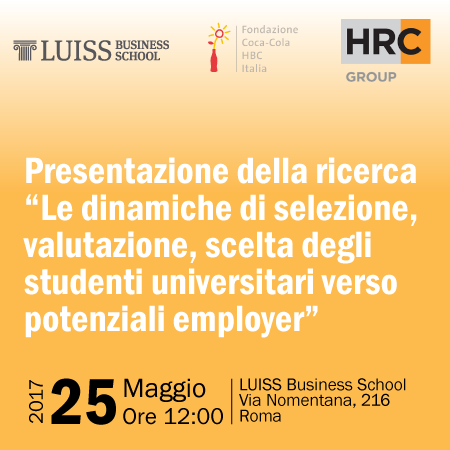
Presentazione della ricerca “Le dinamiche di selezione, valutazione, scelta degli studenti universitari verso potenziali employer”

L’azienda ideale per dare il via alla carriera: come uno studente universitario seleziona i potenziali employer a cui presentare la propria candidatura? Il 25 maggio dalle 12:00 alle 17:30 si terrà la presentazione della ricerca “Le dinamiche di selezione, valutazione, scelta degli studenti universitari verso potenziali employer”, un lavoro svolto dalla LUISS Business School e promosso dalla Fondazione Coca-Cola HBC Italia. Un’analisi delle relazioni tra imprese e studenti secondo un focus innovativo: individuare i fattori che rendono un’azienda appealing agli occhi di uno studente universitario per sviluppare un percorso di carriera. La ricerca fornisce quindi dati e informazioni utili per le imprese che vogliono essere competitive attuando strategie che attraggano risorse e talenti nei diversi settori. Un focus specifico dedicato alla trasformazione digitale si terrà durante la tavola rotonda “L’attrattività delle aziende nell’era digitale” e il successivo “Smart workshop Youth Empowered ” dalle 14:30 alle 17:30. Come trasformare una passione in obiettivo di crescita professionale, costruire un percorso di carriera utilizzando al meglio il web e i social per la ricerca di lavoro, far crescere il proprio network e sviluppare strategie di personal branding saranno i temi principali al centro dell’incontro. REGISTRATI Agenda Smart workshop Youth Empowered 12/05/2017

08 Maggio 2017

Life begins at the end of your comfort zone: the career of Alessandro after the LUISS MBA

MBA 2015 Over my desk hangs a saying: “Life begins at the end of your comfort zone”. Life is more enjoyable when I experience new adventures, both in my personal life and in business.  When it came time to choose an MBA program, I wanted one that would stretch me.  So I chose the LUISS MBA. I learned from challenging classes, valuable soft skill labs, carefully selected international students and talented international faculty. I had opportunities to meet influential CEOs from Italian and international companies, as well as board members and experienced managers. The LUISS MBA was the perfect mix between academia and a learning by doing experience. And Rome was the perfect setting for this experience. It was literally possible to breathe in all the ancient history coming from the past as well as the modernity of a capital city. Nightlife was another plus because there are many places where students can experience unforgettable nights. The result of this mixture was something unique because the challenging environment fit perfectly with the charming city and the business school location. Before joining the LUISS MBA program, I worked as a consultant and an entrepreneur in the medical equipment industry, selling products and services for private clinics. I wanted to make a career change to a larger company, and the LUISS career services team suggested many opportunities with well-known Italian and international companies. Currently I am a Buyer for Babcock Mission Critical Services in the rotary wings division (part of the UK company Babcock International Group). We save lives every day in our core business of HEMS service (Helicopter Emergency Medical Service).  The LUISS MBA helped me develop the tools to succeed. Mental flexibly, stress management, hard skills and negotiation abilities are valuable allies in my current professional life. All were improved in the LUISS MBA through academic lessons and practical training. To be accepted in the LUISS MBA program, it was essential to have two big qualities: motivation and skills. To cover the cost, I applied for the “AdVenture” full tuition scholarship, making a business plan for an innovative idea. When the LUISS Admissions Office called, I was excited to hear that I was one of the winners. It taught me that if you are resilient and believe in your dreams, no one can stop you. The LUISS MBA is a 360-degree program that changed my life, taking me far past my comfort zone. I loved every minute of this incredible learning experience.

04 Maggio 2017

Welcome Day Specialised Course in IP Management and Valuation

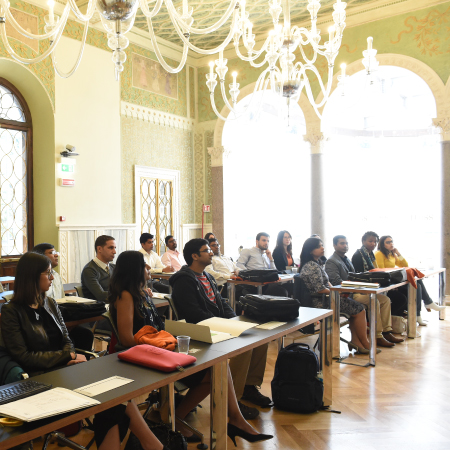
LUISS Business School welcomed the international students for the Specialised Course in IP Management and Valuation, the programme offered jointly with the Italian Patent and Trademark Office and the World Intellectual Property Organization (WIPO, through the WIPO Academy). The teaching plan covering courses on: Industrial and IP Law, International IP Granting Procedure, Innovation Management, IP at University, IP-enabled Business Models, IP Data Analysis, Emergent Issues in IP and Business and IP Valuation. As pointed out by the Dr Loredana Gulino - General Director of the Italian Patent and Trademark Office – “this course is a training opportunity that bears witness to Italy's constant commitment to foster a constructive international dialogue in the field of intellectual property. Considering that products and technologies employing intensive use of Intellectual Property Rights represent an important component of the “Made in Italy” compartment and of Italian excellence, this course also represents an opportunity to increase partnerships with target countries within the whole framework of international counterfeiting and piracy struggles, which have a negative impact on the socio-economic interests of our country. I take this opportunity to thank our partners, LUISS Business School and WIPO Academy, for having immediately believed and invested in the organization of this initiative, as active players along with the Ministry of Economic Development. When the idea of this course arose, we were wondering if such an innovative approach could have an actual response. Today I am pleased to report that the interest has been above all expectations. Indeed, the very high number of applications received, well above the limited places available, confirms that, in a digital economy based on knowledge and innovation, intellectual property is internationally recognized as an increasingly prominent issue for civil society, consumers and businesses”. Gallery 04/05/2017

04 Maggio 2017

Intelligence e magistratura. Dalla diffidenza reciproca alla collaborazione necessaria

Un rapporto – quello tra intelligence e magistratura – che ha segnato storicamente le vicende della Repubblica Italiana. Il libro di Mario Caligiuri “Intelligence e magistratura. Dalla diffidenza reciproca alla collaborazione necessaria” indaga su come un allineamento tra i due corpi istituzionali possa costituire una risorsa per le sfide future delle democrazie contemporanee.  La sinergia tra Intelligence e Magistratura può rivelarsi una strada utile da sviluppare per sostenere la risposta da parte delle élite pubbliche di fronte ai rischi del terrorismo e della criminalità, salvaguardando la sicurezza della collettività dei cittadini. Un libro che indaga su un tema rilevante che anima da anni il dibattito politico con un taglio rigoroso ma al tempo stesso divulgativo: alla presentazione che si terrà il 24 maggio alle h. 16:30 presso l’Università LUISS “Guido Carli” sarà presente l’autore Mario Caligiuri. Mario Caligiuri è professore di prima fascia all’Università dell Calabria. Dal 1999 ha avviato corsi di intelligence nelle università pubbliche italiane dando dignità e legittimazione alla materia. Tra i suoi ultimi volumi Cyber Intelligence. Tra libertà e sicurezza (Donzelli, 2016) e, per Rubettino, Intelligence e scienze umane- Una disciplina accademica per il XXI secolo (2016). Programma Interverranno: Prof.ssa Paola Severino, Rettore LUISS Guido Carli Paolo Boccardelli, Direttore LUISS Business School Carlo Mosca, Consigliere di Stato Luciano Violante, Presidente Associazione “italiadecide” Raffaele Marchetti, Docente LUISS Guido Carli Paolo Messa, Direttore Centro Studi Americani di Roma Florindo Rubettino, Editore Interverrà l’autore del libro Mario Caligiuri. L’evento è gratuito, per motivi organizzativi è gradita la registrazione. REGISTRATI 04/05/2017

03 Maggio 2017

The path to leadership according to Sir Martin Sorrell: a long-term commitment to the creation of value

On  March 16 2017 Sir Martin Sorrell, CEO of WPP was guest at L4T – Leader for Talent –  a series of meetings aimed for Specialized Masters and MBA Students. This insight was written by Cristina Maria Mion, Student of Full Time MBA. On March 16th, students, professors and entrepreneurs had the unique opportunity to engage in an open discussion with Sir Martin Sorrell, CEO of WPP - the world’s leading company in marketing communications services, through the LUISS Business School Leader for Talent #L4T series. Sir Martin Sorrell approached the conference in a two-way conversation, using his keen ability to recognize global trends, and his vast personal experiences, to answer questions at the forefront of the audience’s mind. The interactivity and personal insights were characteristic of today’s style of communication, and offered an enriching experience for the leaders of tomorrow to engage with an individual who has shaped the business world of today. Sir Martin initiated the discussion by sharing his perspective on those trends that are defining the global market and the actions of its members. A time characterized by low GDP growth and minimal inflation, rising cost pressure, emergence of disruptive technologies, and a growing number of active investors, represent unique challenges for current and future leaders. The most significant of these challenges was identified to be the pursuit of balance whilst facing opposing pressures. Sorrell highlighted the importance for leaders to balance the increasing demand for short-term returns and cost-cuts, alongside the growing necessity that firms adopt a more sustainable long-term perspective to growth, capital investment, and value creation. At an individual level, Sorrell translated this into an ability to balance execution and strategy, that is, that successful leaders have the capacity to inspire and develop strategic visions, without losing sight of the technical performance details necessary to bring them to fruition. Sir Martin also shared with the students his personal leadership values which are characterised by a combination of persistence and speed, a refusal to be deterred by challenges, and a keen belief that nothing is impossible. For the future leaders in the audience, this insight was invaluable and brought a renewed a sense of strength to move forward in the pursuit of meaningful change, despite the somewhat uncertain waters of today’s economy. Sorrell’s own path to leadership was influenced by advice given to him by his father who stated that “you should find an industry you enjoy, find a company you like, build a reputation in that company, and if at a certain stage, you want to go and start something on your own go and do it.” Sir Martin maintained that this piece of advice should be held true for all those pursuing leadership positions today, with the understanding that the path to leadership is neither short nor linear, but instead requires a long-term commitment to the creation of value whilst facing cyclical changes, emerging obstacles, and opposing economic pressures. The leadership conference with Sir Martin Sorrell was a highly engaging and informative event that offered future leaders the opportunity to not only better understand the aspects that are shaping the business world of today, but how to can respond to those elements and develop into the leaders that will contribute to the business world of tomorrow. (Article by Cristina Maria Mion, Full Time MBA Student)   Gallery   03/05/2017

03 Maggio 2017

Prende il via la prima edizione del MaDE

  Al via oggi la prima edizione del MaDE - Master in Digital Export realizzato dall’Agenzia ICE in collaborazione con la LUISS Business School. Un master innovativo che guarda al piano Industria 4.0, per formare una nuova generazione di export manager capaci di comprendere ed interpretare le dinamiche di esportazione su scala globale, declinandole nelle nuove tecnologie e cogliendo le opportunità offerte dalla digitalizzazione. Attingendo al meglio delle faculty di ICE e LUISS, il Master coniuga infatti i temi classici dell’internazionalizzazione con quelli specifici del digitale per fornire ai 22 neolaureati selezionati gli strumenti utili per supportare le imprese italiane nell’export attraverso un utilizzo consapevole e trasversale delle tecnologie di informazione e comunicazione (ICT – Information & Communication Technology) e del web marketing, sia in contesti B2C che in contesti B2B. Un percorso di 10 mesi, strutturato in due parti: una prima fase d’aula seguita da un field project che permetterà a ciascun allievo di operare concretamente in una realtà aziendale sviluppando un progetto di export. La seconda fase prevede 2 mesi in Italia e altri due all’estero presso PMI selezionate con il supporto degli Uffici della rete estera dell’Agenzia ICE.  “Il processo di internazionalizzazione delle imprese troverà sempre di più nel digitale uno dei fattori chiave di successo – ha sottolineato Michele Scannavini, Presidente dell’Agenzia ICE. Vi è quindi la necessità di formare figure specifiche che sappiano comprendere e interpretare le nuove dinamiche di esportazione su scala mondiale e che rispondano alla richiesta delle aziende italiane di una cultura manageriale sempre più internazionale. Il Master in Digital Export assicurerà la nascita di export manager che, attraverso un utilizzo consapevole delle tecnologie di informazione, comunicazione e web marketing, potranno aiutare le nostre imprese a crescere sui mercati stranieri.”  “Il Master in Digital Export è un progetto formativo di importanza strategica per il nostro Paese, contribuendo allo sviluppo professionale di giovani export manager che siano in grado di gestire efficacemente il mutamento culturale ed organizzativo imposto alle imprese dalla digitalizzazione – ha dichiarato Paolo Boccardelli, Direttore LUISS Business School. È una grande opportunità riservata ai giovani che prenderanno parte a questo progetto, che conferma la volontà della LUISS Business School di rappresentare un luogo di confronto e condivisione tra mondo pubblico e privato proprio sul tema della digitalizzazione, assicurando competenze fondamentali per poter interpretare e guidare i nuovi trend dello scenario manageriale.” 03/05/2017

28 Aprile 2017

Le voci Wikipedia editate dagli studenti LUISSBusiness nell’edit-a-ton di #WikiTIM

  «Brand Identity», «Crisi d’impresa», «Sovraindebitamento», «Start-up innovativa», «Donazione di cosa altrui», «Transazione fiscale», «Pianificazione di progetto» sono le sette voci di Wikipedia che gli studenti dei master della LUISS Business School hanno aggiornato o editato ex novo per il progetto #WikiTIM. Il contributo degli studenti è stato presentato in occasione l’edit-a-thon del progetto che si è svolto oggi presso la sede di Villa Blanc della LUISS Business School, alla presenza del Prof. Raffaele Oriani, Direttore del programma MBA della LUISS Business School, di Ivan Dompé, Direttore Institutional Communication di TIM,  di Elisabetta Zurovac, Università di Urbino e di Luca Martinelli, Responsabile progetti e membro del Direttivo di Wikimedia Italia. WikiTIM è un’iniziativa di TIM in collaborazione con Wikimedia Italia che coinvolge le università italiane con l’obiettivo di divulgare una cultura digitale scientifica e neutrale: la tappa di Roma è seguita ai precedenti appuntamenti presso l’Università di Urbino e il Politecnico di Milano. “Il web rappresenta la prima fonte di informazione per tutti e soprattutto l’utilizzo dei social media diventa un punto di riferimento importante per le decisioni dei singoli e delle imprese. Sono state selezionate – ha spiegato Ivan Dompé – alcune voci che risultavano carenti sull'enciclopedia online e, con l'aiuto degli studenti e dei professori, il team di Wikipedia le ha aggiornate, rendendole esaustive e affidabili anche grazie ai materiali che TIM ha messo a disposizione dal proprio archivio storico. Qui alla Luiss la collaborazione è stata con ventidue ragazzi dei master della Business School, un'eccellenza nell'ambito dei temi economici”. “Le voci riguardanti argomenti molto specifici, che necessitano di fonti specialistiche, difficilmente possono essere realizzate da un volontario durante il suo tempo libero. Con #WikiTIM – ha dichiarato Luca Martinelli, Responsabile progetti di Wikimedia Italia –  i ragazzi possono mettere in pratica quello che studiano e mostrarne l’importanza e il valore. Soprattutto, il progetto fa capire a tutti, studenti e professori, che Wikipedia non è soltanto il sito da cui si copia la ricerca all’ultimo secondo, ma un mezzo di divulgazione della conoscenza che deve essere curato anche da loro”. “Le nuove tecnologie digitali – ha dichiarato Paolo Boccardelli, Direttore LUISS Business School - stanno cambiando la società e l’economia. Ciò che appare oggi evidente è che questa rivoluzione ha modificato in modo sostanziale l’accesso alle informazioni, che è diventato universale per tutti. È la capacità di individuare le informazioni giuste tra le tante, per saperle leggere e interpretare, a fare la differenza: per questo è fondamentale sviluppare il pensiero critico. Nell’era delle fake news e della post-verità #WikiTIM trasmette ai giovani un valore essenziale, il valore di un’informazione neutrale e fondata, rispetto ad un’informazione distorta e non verificata”. 28/04/2017

Nessun articolo trovato